Prometheus Metrics and Audit Logging
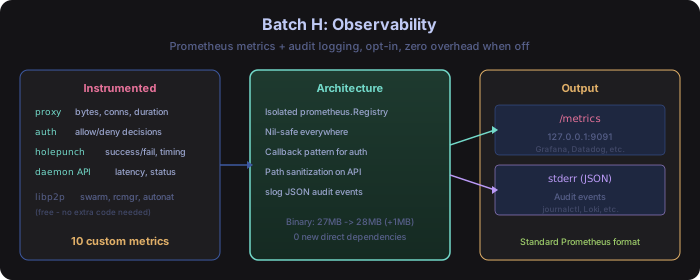
What’s new
Shurli now exposes a Prometheus /metrics endpoint and structured audit logging. Both are opt-in, disabled by default, with zero overhead when off. Enable them in your config:
telemetry:
  metrics:
    enabled: true
    listen_address: "127.0.0.1:9091"
  audit:
    enabled: true
Why it matters
You can’t fix what you can’t measure. Before Batch H, the only way to understand what Shurli was doing was reading log output. Now you can track proxy throughput, auth decisions, hole punch success rates, and API latency with any Prometheus-compatible tool.
This is also the foundation for Batch I (Adaptive Path Selection). Smart path decisions need connection quality data, and the metrics pipeline provides it.
Technical highlights

10 custom shurli metrics
- Proxy: bytes transferred, connections established, active sessions, session duration (per service)
- Auth: allow/deny decision counts
- Hole punch: success/failure counts, timing histograms
- Daemon API: request counts, latency histograms (with path sanitization to prevent label explosion)
- Build info: version and Go version as labels
Free libp2p metrics (no extra code)
When metrics are enabled, all libp2p built-in metrics appear automatically: swarm connections by transport, autonat reachability, resource manager limits, relay service stats, and identify events. These come from libp2p.PrometheusRegisterer(reg) with zero additional instrumentation.
Structured audit events
Auth decisions, service ACL denials, API access, and auth changes are logged as structured JSON events via log/slog:
{"time":"...","level":"WARN","msg":"auth_decision","audit":{"peer":"12D3KooW...","direction":"inbound","result":"deny"}}Why Prometheus, not OpenTelemetry
The original roadmap said “OpenTelemetry integration.” Research showed this was the wrong choice for Shurli:
- libp2p v0.47.0 emits metrics natively via
prometheus/client_golang, not OTel - Adding the OTel SDK would add ~4MB to the binary
- Distributed tracing has 35% CPU overhead from span management on every stream
prometheus/client_golangwas already in our dependency tree (indirect dep of libp2p)
The Prometheus bridge (go.opentelemetry.io/contrib/bridges/prometheus) can forward all metrics to any OTel backend later, without changing a single line of instrumentation code.
Design decisions
- Isolated registry: Each
Metricsinstance usesprometheus.NewRegistry(), not the global default. Tests get their own registry. No collision with other Prometheus users. - Nil-safe everywhere: Every call site checks for nil metrics/audit.
InstrumentHandlerreturns the handler unchanged when both are nil. - Callback pattern for auth:
internal/authcan’t importpkg/p2pnet(circular import). AnAuthDecisionFunccallback is wired in the startup code to feed both metrics counters and audit events. - Path sanitization:
/v1/auth/12D3KooW...becomes/v1/auth/:idin metrics labels to prevent high cardinality.
Grafana dashboard included
A pre-built Grafana dashboard ships in grafana/shurli-dashboard.json. Import it into any Grafana instance to get 29 panels across 6 sections:
- Overview - version, uptime, active connections, total bytes, auth summary
- Proxy Throughput - bytes/sec per service, active connections, connection rate, session duration percentiles
- Security - auth allow/deny rate, cumulative decision counts
- Hole Punch - attempt counts, success rate gauge, duration percentiles
- Daemon API - request rate by path, latency percentiles, status code breakdown
- System - memory, goroutines, GC rate, file descriptors, CPU
Impact
| Metric | Value |
|---|---|
| Binary size | 27MB to 28MB (+1MB) |
| New dependencies | 0 (prometheus already indirect) |
| CPU overhead (disabled) | Zero (DisableMetrics()) |
| New files | 5 (metrics.go, audit.go, middleware.go, tests, Grafana dashboard) |
| Modified files | 10 |
| New tests | 20+ |
Batch H is the eighth development batch. See the monitoring guide for Prometheus + Grafana setup, and the engineering journal for the full decision trail.