Post-Phase 8: Public Seeds, Better Onboarding, Hardened Internals
What changed
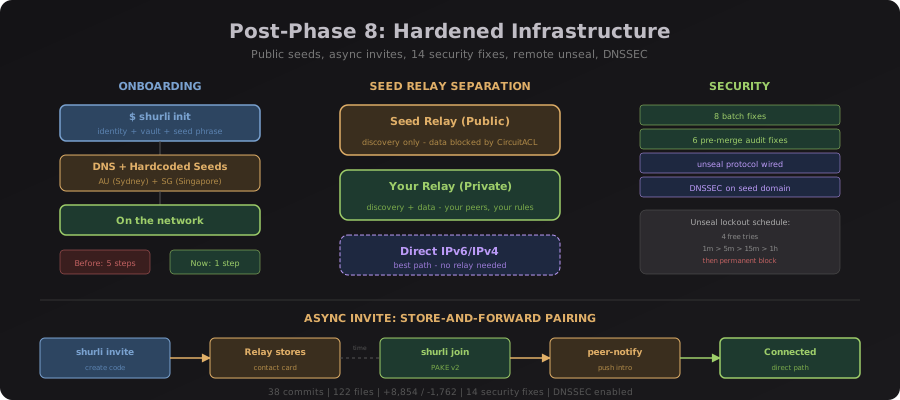
This is not a new phase. It is the hardening pass that turns Phase 8’s raw capability into a product people can actually use. Thirty-eight commits across 122 files. The highlights: public seed relays are live, onboarding is drastically simpler, and 14 security findings were identified and fixed.
What this means for you
You can connect without knowing anyone. Public seed relays in two regions (AU and SG) are now hardcoded into the binary and published as DNS TXT records. Run shurli init, pick your password, and you are on the network. No relay address to copy-paste, no configuration file to edit.
First run is one step. shurli init now creates your identity, initializes the vault, generates your seed phrase, and connects to seeds. One password prompt, one seed to write down, done. Previously this was five separate steps.
Inviting peers is simpler. Start your daemon, run shurli invite. You get a short code. Your friend runs shurli join <code>. PAKE v2 handles the cryptography. The relay mediates the introduction. Previously, pairing required both peers to be online simultaneously. Now invites survive the inviter going offline: the relay stores the introduction and delivers it when both peers reconnect.
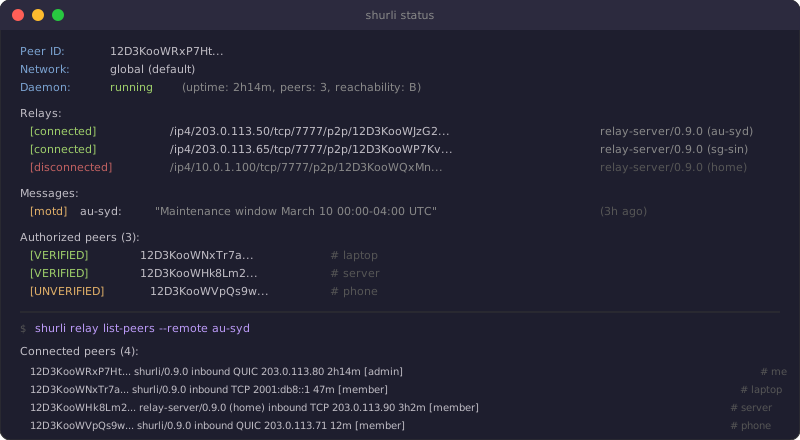
You can see what your relay is doing. shurli status shows relay connectivity, operator messages, and peer verification status. shurli relay list-peers shows connected peers with transport details. Relay names show up next to addresses (configured via the name field in relay config). Connection status is visible: [connected] or [disconnected]. If the relay operator set a message of the day, you see it on connect.
Continuous ping works properly. shurli ping <peer> now loops client-side instead of sending a single ping with count=1000000. Ctrl+C prints a summary with min/avg/max/loss stats. Matches how you expect ping to behave.
Seed relay separation
The most important architectural change: public seed relays are discovery-only. They connect your node to the DHT and help peers find each other, but they do not relay your data by default.
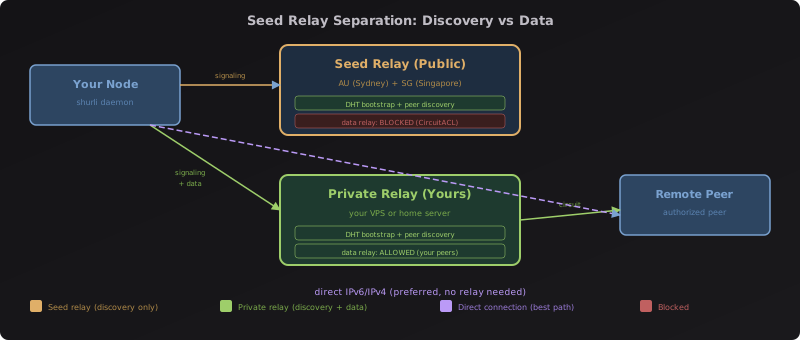
This is a deliberate separation:
| Relay type | Discovery | Data relay | Who runs it |
|---|---|---|---|
| Seed relay | Yes | No (unless admin/relay_data) | Shurli project |
| Private relay | Yes | Yes | You or someone you trust |
| Peer relay | Via DHT | Yes (among authorized peers) | Any peer with a public IP |
Why this matters: seed relays scale to thousands of nodes without bandwidth concerns. Your SSH sessions, file transfers, and XRDP streams go direct (IPv6/IPv4) or through relays you explicitly trust. The seed relay never sees your data unless you are an admin or have relay_data=true in its authorized_keys.
The circuit ACL enforces this server-side. It cannot be bypassed by a client. And as of this release, the ACL caches its authorization data in memory instead of reading the authorized_keys file on every circuit decision.
Async invite flow
The invite system was redesigned. Previously, both peers had to be connected to the relay simultaneously during pairing. Now the relay acts as a store-and-forward intermediary:
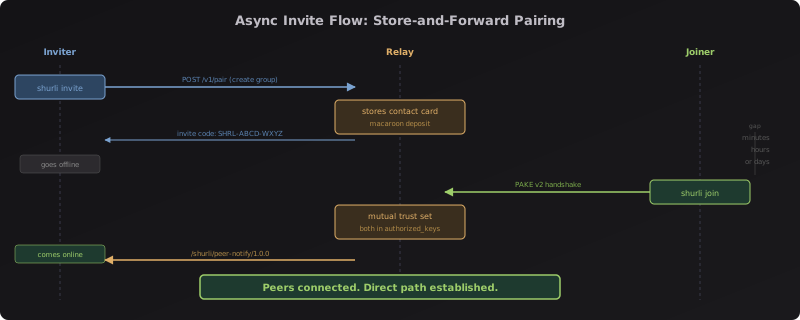
- Inviter creates an invite code (short, relay-mediated)
- The relay stores a “contact card” (introduction) for the joiner
- Joiner runs
shurli join <code>at any time, even days later - PAKE v2 handshake completes, establishing mutual trust
- Relay pushes the introduction to the inviter’s daemon via
/shurli/peer-notify/1.0.0
The contact card is a macaroon-backed deposit. It can be attenuated (restricted) but never widened. If the inviter wants to limit the invite to SSH-only access with a 24-hour window, they set those caveats at creation time.
Vault auto-init
New nodes no longer need to manually initialize the vault. shurli init detects a fresh install and runs the full init sequence: password, seed phrase display, vault creation. One prompt, one flow.
Relay setup follows the same pattern. relay-setup.sh handles everything: install Go, build the binary, create the service user, generate config, initialize the vault. FHS paths (/usr/local/bin, /etc/shurli, /var/lib/shurli) instead of scattered locations.
Security hardening (14 findings fixed)
Two rounds of security review. The first batch (8 findings) was committed earlier in the cycle. The pre-merge audit found 6 more. All fixed before merge.
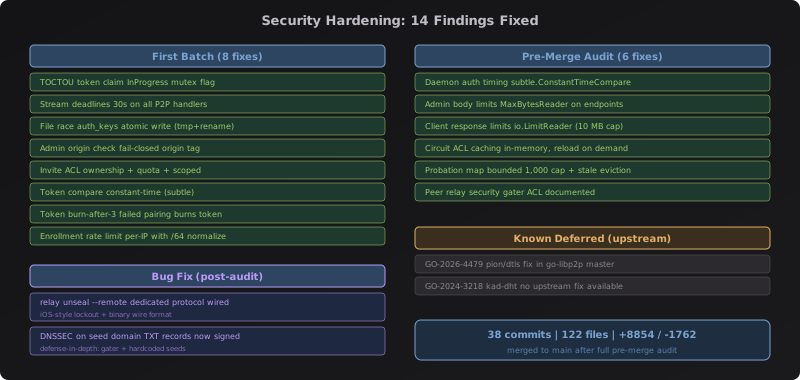
First batch (8 fixes)
- TOCTOU in token claim: pairing tokens now use an
InProgressflag under mutex to prevent double-claim races - Stream deadlines: all P2P protocol handlers now set 30-second deadlines
- File race in authorized_keys: atomic write pattern (write temp, rename) prevents partial reads
- Admin origin check: fail-closed origin tagging on remote admin requests
- Invite ACL: group ownership enforcement, per-peer invite quota, scoped listing
- Token constant-time comparison:
crypto/subtle.ConstantTimeComparefor all token lookups - Token burn-after-three: failed pairing attempts burn the token after 3 tries
- Enrollment probation: per-IP rate limiting with IPv6 /64 normalization
Pre-merge audit (6 fixes)
- Daemon auth timing: switched from
==tosubtle.ConstantTimeComparefor bearer token - Admin body limits: added
http.MaxBytesReaderto authorize/deauthorize endpoints - Client response limits: added
io.LimitReader(10 MB cap) on daemon client - Circuit ACL caching: authorized_keys data cached in memory, refreshed on auth-reload (was reading file per circuit decision)
- Probation map bounded: IP cooldown map capped at 1,000 entries with stale eviction
- Peer relay security documented: connection gater is the ACL for peer relays (explicit design boundary)
Remote unseal protocol fix
relay unseal --remote was broken: the client sent POST /v1/unseal through the generic admin proxy, which correctly blocks it (passphrase should not travel through a generic JSON adapter). The dedicated /shurli/relay-unseal/1.0.0 protocol existed but was never registered as a stream handler.
Fixed: the relay now registers the UnsealHandler on the dedicated protocol, and the CLI opens a stream directly on /shurli/relay-unseal/1.0.0. This gives remote unseal its own security properties:
- Binary wire format (not JSON through a generic adapter)
- iOS-style escalating lockout: 4 free tries, then 1 minute, 5 minutes, 15 minutes, 1 hour, permanent block
- Per-peer failure tracking: each admin peer’s attempts tracked independently
- Dedicated metrics:
vault_unseal_total,vault_unseal_locked_peers
DNSSEC for DNS seeds
The seed domain’s _dnsaddr TXT records are now DNSSEC-signed. This prevents DNS spoofing of bootstrap records. Defense-in-depth: even without DNSSEC, the ConnectionGater rejects unauthorized peers post-bootstrap, and hardcoded fallback seeds in the binary provide an independent bootstrap path.
Known deferred
Two upstream vulnerabilities remain without fixes:
- GO-2026-4479 (pion/dtls v2 nonce reuse): fix merged on go-libp2p master, waiting for v0.48.0 release
- GO-2024-3218 (kad-dht): no upstream fix available
Go 1.26.1 security release is available (March 5). Upgrade recommended.
What is next
- Phase 9: Visual Channel (“Constellation Code”) for visual verification
- Phase 10: Plugin SDK, exposing all internal capabilities to third-party developers
- Phase 11: Distribution (apt, brew, snap) and public launch
The onboarding story is now: install, init, connect. Three steps to a private P2P network. The infrastructure is hardened. The relays are public. The next push is making it beautiful.