Build Tooling, Encrypted Pairing, and Private Networks
What’s new
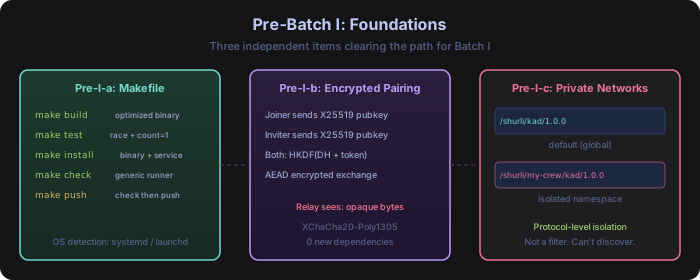
Three independent foundational items shipped as Pre-Batch I, clearing the path for Batch I (Adaptive Path Selection):
- Build & Deployment Tooling - Makefile with 12 targets
- Encrypted Invite/Join Handshake - relay can’t observe pairing tokens
- Private DHT Networks - protocol-level isolation between peer groups
Pre-I-a: Makefile
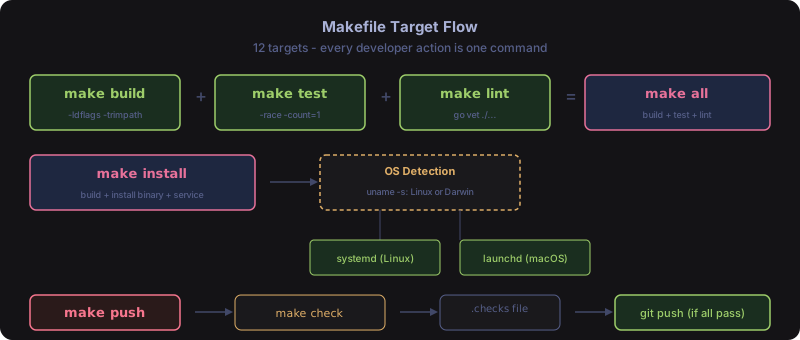
Every developer action now has a single command:
make build     # optimized binary with version/commit/date injection
make test      # go test -race -count=1 ./...
make install   # build + install binary + install systemd/launchd service
make check     # run commands from .checks file, fail on any non-zero
make push      # make check && git push (impossible to push without checks passing)
OS detection routes make install-service to the right init system: Linux gets systemd, macOS gets launchd. Clear messaging before any sudo operation.
Generic checks runner: make check reads a .checks file (gitignored, user-created) and runs each line. The Makefile target is entirely generic. What you check is up to you.
Why this matters
- Consistency: Every contributor runs the exact same build flags, test flags, and lint checks. No “works on my machine” drift.
- Safety gate:
make pushmakes it impossible to push code that fails checks. The.checksfile is yours to customize, so you define what “safe to push” means for your setup. - Cross-platform install: One command installs the binary and sets up the right service manager (systemd on Linux, launchd on macOS). No manual service file copying or editing.
- Version injection: Every binary knows its exact version, commit hash, and build date.
shurli versionalways tells you precisely what you’re running.
Pre-I-b: Encrypted invite/join handshake
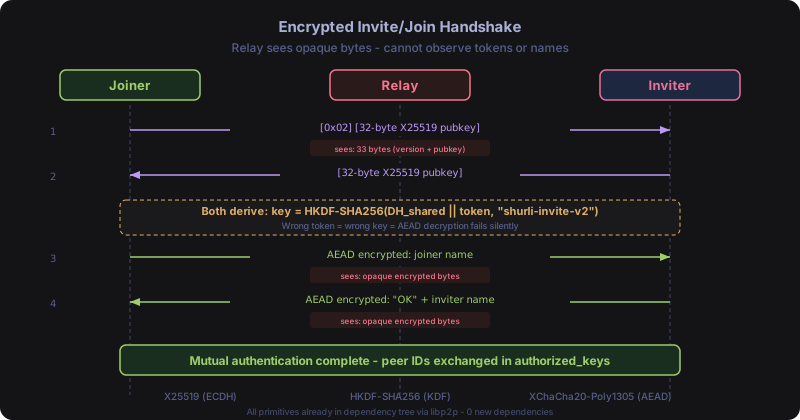
The invite/join pairing now uses an encrypted handshake. Before, the invite token was sent as cleartext hex over the stream. A malicious relay operator could observe it. Now the relay sees only opaque encrypted bytes.
How it works
1. Joiner -> Inviter:  [version 0x01] [32-byte X25519 public key]
2. Inviter -> Joiner:  [32-byte X25519 public key]
   -- Both derive: key = HKDF-SHA256(DH_shared || token, "shurli-invite-v2")
3. Joiner -> Inviter:  [AEAD encrypted: joiner name]
4. Inviter -> Joiner:  [AEAD encrypted: "OK" + inviter name]
Both sides compute an ephemeral X25519 Diffie-Hellman shared secret, mix it with the invite token via HKDF, and derive an XChaCha20-Poly1305 AEAD key. If the tokens don’t match, HKDF produces different keys and AEAD decryption fails silently. The inviter logs “invalid invite code” with no protocol details leaked.
What the relay sees
| Before | After |
|---|---|
| Token hex in cleartext | Ephemeral public keys + encrypted bytes |
| Peer names in cleartext | Encrypted bytes |
| Could replay token | Can’t reconstruct AEAD key |
Zero new dependencies
crypto/ecdh (Go stdlib), golang.org/x/crypto/hkdf, and golang.org/x/crypto/chacha20poly1305 were all already in the dependency tree via libp2p. Binary size: unchanged.
Backward compatibility
Invite code version byte determines the protocol. Originally: 0x01 = legacy cleartext, 0x02 = encrypted handshake. Post-I-1 deleted the cleartext protocol and renumbered: 0x01 = PAKE-encrypted invite, 0x02 = relay pairing code. Future versions (0x03+) are rejected with a “please upgrade shurli” message.
v2 invite codes carry the namespace
v2 invite codes include a namespace field. When you join a private network, the joiner auto-inherits the inviter’s DHT namespace in their config. No extra flags needed.
Why this matters
- Relay resistance: Even if you use a relay you don’t fully trust, your invite token and peer names are never visible to it. The relay forwards encrypted bytes it cannot decrypt.
- Silent failure on wrong token: A brute-force attacker gets no feedback. Wrong token = wrong HKDF key = AEAD decryption fails = connection closes. No error messages, no timing leaks.
- Forward secrecy: Ephemeral X25519 keys are generated per handshake. Compromising one session reveals nothing about past or future pairings.
- Zero cost: All cryptographic primitives were already in the dependency tree via libp2p. No new imports, no binary size increase, no new attack surface from third-party crypto libraries.
Pre-I-c: Private DHT networks
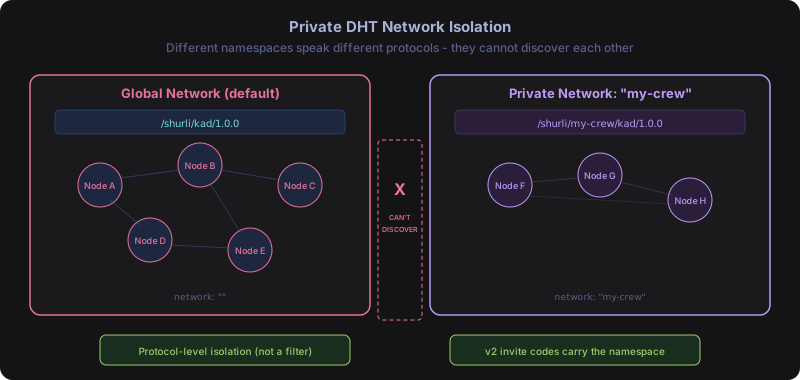
Nodes can now form completely isolated peer groups by setting a network namespace:
shurli init --network "my-crew"This produces a config with:
discovery:
  rendezvous: "shurli-default-network"
  network: "my-crew"
Protocol-level isolation
The DHT protocol prefix becomes /shurli/my-crew/kad/1.0.0. Nodes on different namespaces speak entirely different protocols. They don’t just filter each other out. They literally cannot discover each other. This is a protocol-level guarantee, not an application-layer filter.
| Config | DHT Protocol Prefix |
|---|---|
network: "" (default) | /shurli/kad/1.0.0 |
network: "my-crew" | /shurli/my-crew/kad/1.0.0 |
network: "family" | /shurli/family/kad/1.0.0 |
Status display
$ shurli status
Version:  v0.x.x
Peer ID:  12D3KooW...
Network:  my-crew
Config:   ~/.config/shurli/config.yaml
...
Backward compatibility
Empty or missing network field = global DHT (/shurli/kad/1.0.0). Zero breaking changes for existing deployments.
Why this matters
- True isolation: This isn’t an application-layer filter that hides peers from listings. Nodes on different namespaces speak literally different DHT protocols. They can’t discover each other even if they try.
- Simple setup: One flag at init time (
--network "my-crew") and you’re in your own private network. No additional infrastructure, no separate relay, no configuration files to sync. - Automatic propagation: v2 invite codes carry the namespace. When someone joins your private network, their config is set automatically. No manual coordination needed.
- Scalable group management: Families, teams, organizations can each have their own namespace. Share a relay for transport, but keep peer discovery completely separate.
Impact summary
| Metric | Value |
|---|---|
| New files | 5 (Makefile, pake.go, pake_test.go, network.go, network_test.go) |
| Modified files | 19 |
| New tests | 30+ (19 PAKE + 11 invite code + namespace validation + DHT prefix) |
| New ADRs | 4 (Ia01, Ia02, Ib01, Ib02, Ic01) |
| Binary size | Unchanged (28MB) |
| New dependencies | 0 (golang.org/x/crypto promoted from indirect to direct) |
These three items are the Pre-Batch I foundation. See the engineering journal for the full decision trail on each item.