Architecture
This document describes the technical architecture of Shurli, from current implementation to future vision.
Table of Contents
- Current Architecture - what’s built and working
- Plugin Architecture - extensibility framework, three-layer evolution
- Target Architecture (Phase 9C+) - planned additions
- Observability (Batch H) - Prometheus metrics, audit logging
- Adaptive Path Selection (Batch I) - interface discovery, dial racing, STUN, peer relay
- libp2p Upstream Overrides - where Shurli diverges from stock libp2p
- Core Concepts - implemented patterns
- Security Model - implemented + planned extensions
- Role-Based Access Control (Phase 6) - admin/member tiers
- Macaroon Capability Tokens (Phase 6) - HMAC-chain bearer tokens
- Per-Peer Data Access Grants - time-limited capability grants with macaroon tokens
- Grant Store (Issuer Side) - node-level grant management
- Grant Pouch (Holder Side) - received token storage
- Token Presentation (Stream-Level) - binary grant header on plugin streams
- P2P Grant Delivery Protocol - token delivery, revocation, refresh
- Delegation - multi-hop token attenuation
- Notification Subsystem - multi-channel event routing
- Integrity-Chained Audit Log - tamper-evident grant history
- Grant Receipt Protocol - relay-pushed 62-byte receipts, client cache, smart pre-transfer checks
- Passphrase-Sealed Vault (Phase 6) - relay key protection
- Async Invite Deposits (Phase 6) - client-deposit invites
- ZKP Privacy Layer (Phase 7) - anonymous membership proofs
- Anonymous Relay Authorization (Phase 7) - challenge-response auth
- Private Reputation (Phase 7) - range proofs on scores
- BIP39 Key Management (Phase 7) - deterministic circuit keys
- Unified Seed Architecture (Phase 8) - one BIP39 seed for all keys
- Encrypted Identity (Phase 8) - password-protected identity.key for all nodes
- Remote Admin Protocol (Phase 8) - full relay management over P2P
- MOTD and Goodbye (Phase 8) - signed operator announcements
- Session Tokens (Phase 8) - machine-bound auto-decrypt, lock/unlock
- File Transfer (Phase 9B) - chunked P2P transfer, erasure coding, multi-source (plugin)
- Plugin System - Plugin interface, registry, lifecycle, supervisor
- Naming System - local names implemented, network-scoped and blockchain planned
- Federation Model - planned (Phase 13)
- Mobile Architecture - planned (Phase 12)
Current Architecture
Phase 9B + Plugin Architecture + Per-Peer Data Grants + E14 Relay-First Onboarding + Phase 10 Distribution (install script, release archives, relay-setup –prebuilt) + D1/D3 Security Hardening + Per-Peer Bandwidth Budgets complete.
Component Overview
Shurli/
├── cmd/
│   ├── shurli/              # Single binary with subcommands
│   │   ├── main.go          # Command dispatch (daemon, ping, traceroute, resolve,
│   │   │                    #   proxy, whoami, auth, relay, config, service, invite,
│   │   │                    #   join, verify, plugin, status, init, recover,
│   │   │                    #   change-password, lock, unlock, session, doctor,
│   │   │                    #   completion, man, version)
│   │   │                    #   + plugin-injected: send, download, share, browse,
│   │   │                    #   transfers, accept, reject, cancel, clean
│   │   ├── cmd_daemon.go    # Daemon mode + client subcommands (status, stop, ping, etc.)
│   │   ├── serve_common.go  # Shared P2P runtime (serveRuntime) - used by daemon
│   │   ├── cmd_init.go      # Interactive setup wizard
│   │   ├── cmd_proxy.go     # TCP proxy client
│   │   ├── cmd_ping.go      # Standalone P2P ping (continuous, stats)
│   │   ├── cmd_traceroute.go # Standalone P2P traceroute
│   │   ├── cmd_resolve.go   # Standalone name resolution
│   │   ├── cmd_whoami.go    # Show own peer ID
│   │   ├── cmd_auth.go      # Auth add/list/remove/validate/set-attr + grant dispatch
│   │   ├── cmd_auth_grants.go # Grant CLI: grant, grants, revoke, extend (all --json)
│   │   ├── cmd_auth_audit.go  # Audit log CLI: auth audit [--verify] [--tail N] [--json]
│   │   ├── cmd_relay.go     # Relay add/list/remove/seeds + relay-server dispatch
│   │   ├── cmd_relay_grants.go # Relay grant CLI: grant/grants/revoke/extend (relay admin API)
│   │   ├── cmd_relay_serve.go # Relay server: serve/authorize/info/config
│   │   ├── cmd_relay_vault.go # Vault CLI: init/seal/unseal/status
│   │   ├── cmd_relay_invite.go # Invite CLI: create/list/revoke/modify
│   │   ├── cmd_relay_zkp.go  # ZKP setup: BIP39 seed, SRS, proving/verifying keys
│   │   ├── cmd_relay_motd.go # MOTD/goodbye CLI: set/clear/status, goodbye set/retract/shutdown
│   │   ├── cmd_relay_remote.go # Remote admin --remote flag dispatcher
│   │   ├── cmd_relay_recover.go # Relay identity recovery from seed phrase
│   │   ├── cmd_relay_setup.go # Relay interactive setup wizard
│   │   ├── cmd_relay_unix.go  # Platform-specific relay helpers (Unix)
│   │   ├── cmd_relay_windows.go # Platform-specific relay helpers (Windows)
│   │   ├── cmd_service.go   # Service add/list/remove subcommands
│   │   ├── cmd_config.go    # Config validate/show/set/reload/rollback/apply/confirm
│   │   ├── cmd_invite.go    # Generate invite code + QR + P2P handshake (--non-interactive)
│   │   ├── cmd_join.go      # Decode invite, connect, auto-configure (--non-interactive, env var)
│   │   ├── cmd_status.go    # Local status: version, peer ID, config, services, peers
│   │   ├── cmd_verify.go    # SAS verification (4-emoji fingerprint)
│   │   ├── cmd_plugin.go      # Plugin CLI: list/enable/disable/info/disable-all
│   │   ├── cmd_reconnect.go   # Force reconnect to a peer via daemon API (--json)
│   │   ├── cmd_notify.go      # Notification CLI: test/list (--json)
│   │   ├── cmd_recover.go    # Top-level identity recovery from seed phrase
│   │   ├── cmd_change_password.go # Top-level password change
│   │   ├── cmd_lock.go       # Lock/unlock/session commands
│   │   ├── cmd_seed_helpers.go # Shared seed confirmation quiz + password prompts
│   │   ├── cmd_doctor.go     # Health check + auto-fix (completions, man page, config)
│   │   ├── cmd_completion.go # Shell completion scripts (bash, zsh, fish)
│   │   ├── cmd_man.go        # troff man page (display, install, uninstall)
│   │   ├── config_template.go # Shared node config YAML template (single source of truth)
│   │   ├── relay_input.go   # Flexible relay address parsing (IP, IP:PORT, multiaddr)
│   │   ├── seeds.go         # Hardcoded bootstrap seeds + DNS seed domain constant
│   │   ├── serve_common.go  # Shared runtime setup (daemon + relay: P2P, metrics, watchdog)
│   │   ├── daemon_launch.go # Service manager restart (launchd/systemd kick)
│   │   ├── daemon_launch_windows.go # Service manager restart (Windows stub)
│   │   ├── flag_helpers.go  # Shared CLI flag parsing helpers
│   │   ├── flagorder.go     # Flag reordering (positional args after flags)
│   │   └── exit.go          # Testable os.Exit wrapper
│
├── pkg/sdk/              # Importable P2P library
│   ├── network.go           # Core network setup, relay helpers, name resolution
│   ├── service.go           # Service registry (register/unregister, expose/unexpose)
│   ├── service_query.go     # Service query protocol (/shurli/service-query/1.0.0)
│   ├── proxy.go             # Bidirectional TCP↔Stream proxy with half-close + byte counting
│   ├── naming.go            # Local name resolution (name → peer ID)
│   ├── identity.go          # Identity helpers (delegates to internal/identity)
│   ├── contracts.go         # Public API interfaces (PeerNetwork, Resolver, ServiceManager, Authorizer)
│   ├── events.go            # Typed event system (EventType, Event, EventBus)
│   ├── protocolid.go        # Protocol ID formatter + init-time validation
│   ├── bootstrap.go         # BootstrapAndConnect orchestration (DHT, relay, dial)
│   ├── doc.go               # Package-level documentation
│   ├── ping.go              # Shared P2P ping logic (PingPeer, ComputePingStats)
│   ├── traceroute.go        # Shared P2P traceroute (TracePeer, hop analysis)
│   ├── verify.go            # SAS verification helpers (emoji fingerprints)
│   ├── reachability.go      # Reachability grade calculation (A-F scale)
│   ├── interfaces.go        # Interface discovery, IPv6/IPv4 classification
│   ├── pathdialer.go        # Parallel dial racing (direct + relay, first wins)
│   ├── pathtracker.go       # Per-peer path quality tracking (event-bus driven)
│   ├── netmonitor.go        # Network change monitoring (event-driven)
│   ├── netmonitor_darwin.go # macOS route socket network change detection
│   ├── netmonitor_linux.go  # Linux netlink network change detection
│   ├── netmonitor_other.go  # Fallback polling for other platforms
│   ├── netmonitor_poll.go   # Interval-based interface polling
│   ├── stunprober.go        # RFC 5389 STUN client, NAT type classification
│   ├── peerrelay.go         # Every-peer-is-a-relay (auto-enable with public IP)
│   ├── relaydiscovery.go    # DHT relay discovery + RelaySource interface + AutoRelay PeerSource
│   ├── relayhealth.go       # EWMA relay health scoring (success rate, RTT, freshness)
│   ├── bandwidth.go         # Per-peer/protocol bandwidth tracking (wraps libp2p BandwidthCounter)
│   ├── dnsseed.go           # DNS seed resolution (_dnsaddr TXT records, IPFS convention)
│   ├── mdns.go              # mDNS LAN discovery (dedup, concurrency limiting)
│   ├── mdns_browse_native.go # Native DNS-SD via dns_sd.h (macOS/Linux CGo)
│   ├── mdns_browse_fallback.go # Pure-Go zeroconf fallback (other platforms)
│   ├── peermanager.go       # Background reconnection with exponential backoff
│   ├── netintel.go          # Presence protocol (/shurli/presence/1.0.0, gossip forwarding)
│   ├── gateway_darwin.go    # Default gateway detection (macOS)
│   ├── gateway_linux.go     # Default gateway detection (Linux)
│   ├── gateway_other.go     # Default gateway detection (fallback)
│   ├── diskspace_unix.go    # Disk space checking (Unix statfs)
│   ├── diskspace_windows.go # Disk space checking (Windows)
│   ├── transfer.go          # SHFT v2 wire format, chunked transfer, receive modes, rate limiting
│   ├── transfer_erasure.go  # Reed-Solomon erasure coding (stripe-based, auto-enable on Direct WAN)
│   ├── transfer_resume.go   # Checkpoint-based resume (bitfield of received chunks, .shurli-ckpt files)
│   ├── transfer_parallel.go # Parallel QUIC streams (adaptive, 1 for LAN, up to 4 for WAN)
│   ├── transfer_multipeer.go # RaptorQ fountain codes for multi-source download
│   ├── transfer_raptorq.go  # RaptorQ symbol encoding/decoding
│   ├── transfer_grants.go   # Relay grant pre-transfer checks, smart reconnection, budget tracking
│   ├── transfer_log.go      # Transfer event logger (JSON lines, file rotation)
│   ├── transfer_notify.go   # Transfer notifications (desktop/command modes)
│   ├── chunker.go           # FastCDC content-defined chunking (own impl, adaptive targets)
│   ├── merkle.go            # BLAKE3 Merkle tree (binary, odd-node promotion)
│   ├── compress.go          # zstd compress/decompress with bomb protection
│   ├── share.go             # ShareRegistry, TransferQueue, browse/download protocols
│   ├── plugin_policy.go     # Transport-aware plugin access control (LAN/Direct/Relay bitmask)
│   ├── grant_header.go      # Binary grant header on plugin streams (4-byte overhead, token presentation)
│   ├── standalone.go        # Standalone mode helpers for CLI commands
│   ├── metrics.go           # Prometheus metrics (custom registry, all shurli collectors)
│   ├── audit.go             # Structured audit logger (nil-safe, slog-based)
│   └── errors.go            # Sentinel errors
│
├── pkg/plugin/              # Plugin framework
│   ├── plugin.go            # Plugin interface contract (Name, Version, Init, Start, Stop, Commands, Routes, Protocols)
│   ├── registry.go          # Plugin discovery, load, enable/disable
│   ├── registry_lifecycle.go # Lifecycle state machine (LOADING -> READY -> ACTIVE -> DRAINING -> STOPPED)
│   ├── registry_helpers.go  # Route conflict detection, handler wrapping
│   ├── registry_query.go    # Plugin query helpers
│   ├── lifecycle.go         # State transitions, validation
│   ├── commands.go          # CLI command registration from plugins
│   ├── completion.go        # Shell completion generation for plugin commands
│   ├── supervisor.go        # Auto-restart with circuit breaker (3 crashes = disable)
│   └── atomicfile.go        # Atomic file writes with fsync
│
├── plugins/                 # Plugin implementations
│   ├── plugins.go           # Plugin registration (all compiled-in plugins)
│   └── filetransfer/        # File transfer plugin (first extraction)
│       ├── plugin.go        # Implements Plugin interface
│       ├── commands.go      # 9 CLI command handlers (send, download, browse, share, etc.)
│       ├── handlers.go      # 14 daemon HTTP handlers
│       ├── client.go        # Daemon client methods for file transfer
│       ├── types.go         # 12 request/response types
│       ├── config.go        # Plugin config section (~30 fields)
│       ├── checkpoint.go    # Transfer checkpoint persistence
│       └── progress.go      # Transfer progress tracking
│
├── internal/
│   ├── config/              # YAML configuration loading + self-healing
│   │   ├── config.go           # Config structs (HomeNode, Client, Relay, unified NodeConfig)
│   │   ├── loader.go           # Load, validate, resolve paths, find config
│   │   ├── archive.go          # Last-known-good archive/rollback (atomic writes)
│   │   ├── confirm.go          # Commit-confirmed pattern (apply/confirm/enforce)
│   │   ├── snapshot.go         # TimeMachine-style config snapshots
│   │   └── errors.go           # Sentinel errors (ErrConfigNotFound, ErrNoArchive, etc.)
│   ├── auth/                # SSH-style authentication + role-based access
│   │   ├── authorized_keys.go  # Parser + ConnectionGater loader
│   │   ├── gater.go            # ConnectionGater implementation
│   │   ├── manage.go           # AddPeer/RemovePeer/ListPeers (shared by CLI commands)
│   │   ├── roles.go            # Role-based access control (admin/member)
│   │   └── errors.go           # Sentinel errors
│   ├── daemon/              # Daemon API server + client
│   │   ├── types.go            # JSON request/response types (StatusResponse, PingRequest, etc.)
│   │   ├── server.go           # Unix socket HTTP server, cookie auth, proxy tracking
│   │   ├── handlers.go         # HTTP handlers, format negotiation (JSON + text)
│   │   ├── handlers_grants.go  # Grant-related daemon API handlers
│   │   ├── handlers_notify.go  # Notification daemon API handlers
│   │   ├── handlers_plugin.go  # Plugin daemon API handlers
│   │   ├── middleware.go       # HTTP instrumentation (request timing, path sanitization)
│   │   ├── client.go           # Client library for CLI → daemon communication
│   │   └── errors.go           # Sentinel errors (ErrDaemonAlreadyRunning, etc.)
│   ├── identity/            # Ed25519 identity management (shared by daemon + relay modes)
│   │   ├── identity.go      # CheckKeyFilePermissions, LoadOrCreateIdentity, PeerIDFromKeyFile
│   │   ├── seed.go          # BIP39 generation, HKDF key derivation, unified seed architecture
│   │   ├── bip39_wordlist.go # BIP39 2048-word English wordlist
│   │   ├── encrypted.go     # SHRL encrypted identity format (Argon2id + XChaCha20-Poly1305)
│   │   └── session.go       # Session tokens: create, read, delete, machine-bound encryption
│   ├── invite/              # Invite code encoding + PAKE handshake
│   │   ├── code.go          # Binary -> base32 with dash grouping
│   │   └── pake.go          # PAKE key exchange (X25519 DH + HKDF-SHA256 + XChaCha20-Poly1305)
│   ├── macaroon/            # HMAC-chain capability tokens
│   │   ├── macaroon.go      # Macaroon struct, HMAC chaining, verify, encode/decode
│   │   └── caveat.go        # Caveat language parser (13 types: peer_id, service, expires, etc.)
│   ├── grants/              # Per-peer data access grant system
│   │   ├── store.go         # GrantStore: issuer-side grant management, HMAC-integrity persistence
│   │   ├── pouch.go         # GrantPouch: holder-side token storage, background refresh
│   │   ├── protocol.go      # P2P grant delivery protocol (/shurli/grant/1.0.0)
│   │   ├── delivery_queue.go # Offline delivery queue (granting node only, not relay)
│   │   ├── audit.go         # Integrity-chained audit log (HMAC-SHA256 chain)
│   │   ├── cache.go         # GrantCache: client-side relay grant receipt cache, budget tracking, persistence
│   │   ├── rate_limit.go    # Per-peer ops rate limiter (10/min default)
│   │   ├── hmac_file.go     # HMAC-integrity file persistence helpers
│   │   └── duration.go      # Duration parsing helpers
│   ├── notify/              # Multi-channel notification subsystem
│   │   ├── router.go        # Event router: dedup, non-blocking dispatch, pre-expiry warnings
│   │   ├── event.go         # Event types (8), severity levels, Event struct
│   │   ├── sink.go          # NotificationSink interface
│   │   ├── sink_log.go      # LogSink: always-on structured slog audit trail
│   │   ├── sink_desktop.go  # DesktopSink: osascript (macOS), notify-send (Linux)
│   │   └── sink_webhook.go  # WebhookSink: HTTP POST with retry, auth headers, event filter
│   ├── totp/                # RFC 6238 time-based one-time passwords
│   │   └── totp.go          # Generate, Validate (with skew), NewSecret, provisioning URI
│   ├── vault/               # Passphrase-sealed relay key vault
│   │   └── vault.go         # Argon2id KDF + XChaCha20-Poly1305, seal/unseal, seed recovery
│   ├── deposit/             # Macaroon-backed async invite deposits
│   │   ├── store.go         # DepositStore: create, consume, revoke, add caveat, cleanup
│   │   └── errors.go        # ErrDepositNotFound, Consumed, Revoked, Expired
│   ├── yubikey/             # Yubikey HMAC-SHA1 challenge-response
│   │   └── challenge.go     # ykman CLI integration (IsAvailable, ChallengeResponse)
│   ├── relay/               # Relay pairing, admin socket, peer introductions, vault unseal, MOTD
│   │   ├── tokens.go        # Token store (v2 pairing codes, TTL, namespace)
│   │   ├── pairing.go       # Relay pairing protocol (/shurli/relay-pair/1.0.0)
│   │   ├── grant_receipt.go  # Grant receipt wire format (62 bytes), encode/decode/verify, relay-side push
│   │   ├── notify.go        # Reconnect notifier + peer introduction delivery (/shurli/peer-notify/1.0.0)
│   │   ├── admin.go         # Relay admin Unix socket server (cookie auth, /v1/ endpoints)
│   │   ├── admin_api.go     # RelayAdminAPI interface (local + remote transparent)
│   │   ├── admin_client.go  # HTTP client for relay admin socket
│   │   ├── remote_admin.go  # Remote admin P2P handler (/shurli/relay-admin/1.0.0)
│   │   ├── remote_admin_client.go # Remote admin client (libp2p stream transport)
│   │   ├── unseal.go        # Remote unseal P2P protocol (/shurli/relay-unseal/1.0.0)
│   │   ├── motd.go          # MOTD/goodbye server: signed announcements (/shurli/relay-motd/1.0.0)
│   │   ├── motd_client.go   # MOTD/goodbye client: receive, verify, store goodbyes
│   │   ├── circuit_acl.go   # Circuit relay ACL filter (admin/time-limited grant gating)
│   │   ├── zkp_auth.go      # ZKP auth protocol handler (/shurli/zkp-auth/1.0.0)
│   │   └── zkp_client.go    # ZKP auth client (prove membership to relay)
│   ├── zkp/                   # Zero-knowledge proof privacy layer
│   │   ├── poseidon2.go       # Native + circuit Poseidon2 hash (BN254)
│   │   ├── merkle.go          # Sorted Merkle tree, power-of-2 padding
│   │   ├── membership.go      # PLONK membership circuit (22,784 SCS)
│   │   ├── range_proof.go     # Range proof circuit (27,004 SCS)
│   │   ├── challenge.go       # Single-use nonce store (30s TTL)
│   │   ├── srs.go             # KZG SRS generation + seed-based setup
│   │   ├── keys.go            # ProvingKey/VerifyingKey serialization
│   │   ├── prover.go          # High-level prover with root extension
│   │   ├── verifier.go        # High-level verifier (public-only witness)
│   │   ├── bip39.go           # BIP39 mnemonic generation + validation
│   │   ├── rln_seam.go        # Rate-limiting nullifier interface
│   │   └── errors.go          # Sentinel errors
│   ├── reputation/            # Peer reputation scoring
│   │   ├── history.go         # Interaction history tracking
│   │   └── score.go           # Deterministic 0-100 scoring (4 components)
│   ├── qr/                  # QR Code encoder for terminal display (inlined from skip2/go-qrcode)
│   │   ├── qrcode.go        # Public API: New(), Bitmap(), ToSmallString()
│   │   ├── encoder.go       # Data encoding (numeric, alphanumeric, byte modes)
│   │   ├── symbol.go        # Module matrix, pattern placement, penalty scoring
│   │   ├── version.go       # All 40 QR versions × 4 recovery levels
│   │   ├── gf.go            # GF(2^8) arithmetic + Reed-Solomon encoding
│   │   └── bitset.go        # Append-only bit array operations
│   ├── termcolor/           # Minimal ANSI terminal colors (replaces fatih/color)
│   │   └── color.go         # Green, Red, Yellow, Faint - respects NO_COLOR
│   ├── platform/            # Platform-specific helpers
│   │   ├── umask_unix.go     # File permission umask (Unix)
│   │   └── umask_windows.go  # File permission umask (Windows stub)
│   ├── validate/            # Input validation helpers
│   │   ├── service.go        # ServiceName() - DNS-label format for protocol IDs
│   │   ├── network.go        # Network address validation (multiaddr, IP, port)
│   │   ├── password.go       # Password strength validation
│   │   ├── display.go        # SanitizeForDisplay() - user-facing string sanitization
│   │   ├── relay_message.go  # SanitizeRelayMessage() - URL/email strip, ASCII whitelist
│   │   └── errors.go         # Sentinel errors
│   └── watchdog/            # Health monitoring + systemd integration
│       └── watchdog.go      # Health check loop, sd_notify (Ready/Watchdog/Stopping)
│
├── deploy/                  # Service management files
│   ├── README.md               # Deployment guide
│   ├── shurli-daemon.service   # systemd unit for daemon (Linux)
│   ├── shurli-relay.service    # systemd unit for relay server (Linux)
│   └── com.shurli.daemon.plist # launchd plist for daemon (macOS)
│
├── tools/                   # Dev and deployment tools
│   ├── install.sh              # One-line installer (curl get.shurli.io | sh)
│   ├── install-go.sh           # Go toolchain installer for relay setup
│   ├── relay-setup.sh          # Relay VPS deploy/verify/uninstall script
│   ├── sync-docs/              # Hugo doc sync pipeline
│   └── importcheck/            # Import boundary checker (pkg/ must not import internal/)
│
├── configs/                 # Sample configuration files
│   ├── shurli.sample.yaml
│   ├── relay-server.sample.yaml
│   └── authorized_keys.sample
│
├── docs/                    # Project documentation
│   ├── ARCHITECTURE.md      # This file
│   ├── COMMANDS.md          # CLI command reference
│   ├── DAEMON-API.md        # Daemon API reference
│   ├── ENGINEERING-JOURNAL.md # Phase-by-phase engineering decisions
│   ├── MONITORING.md        # Prometheus + Grafana monitoring guide
│   ├── NETWORK-TOOLS.md     # Network diagnostic tools guide
│   ├── RELAY-SETUP.md       # Relay server setup guide
│   ├── ROADMAP.md           # Development roadmap
│   ├── TESTING.md           # Test strategy and coverage
│   ├── TROUBLESHOOTING.md   # Common issues and fixes
│   ├── engineering-journal/ # Detailed per-phase journal entries
│   └── faq/               # FAQ sub-pages (comparisons, security, relay, design, deep dives)
│
└── examples/                # Example implementations
    └── basic-service/
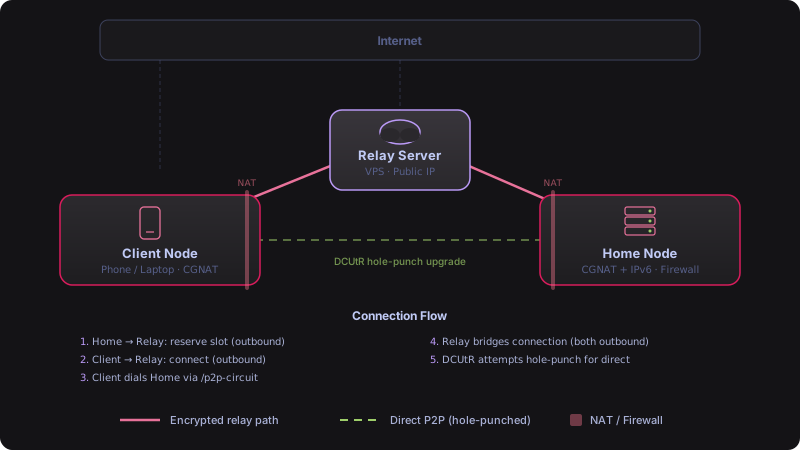
Network Topology (Current)
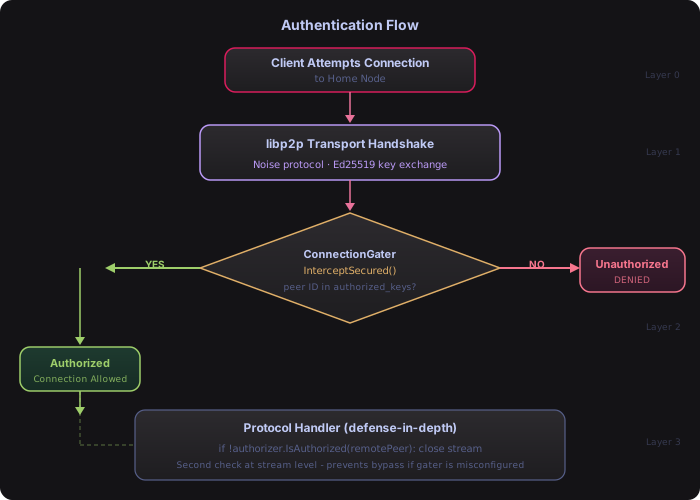
Authentication Flow
Peer Authorization Methods
There are three ways to authorize peers:
1. CLI - shurli auth
shurli auth add <peer-id> --comment "label"
shurli auth list
shurli auth remove <peer-id>
2. Invite/Join flow - zero-touch mutual authorization
Machine A: shurli invite --as home     # Generates invite code + QR
Machine B: shurli join <code> --as laptop  # Decodes, connects, auto-authorizes both sides
The invite protocol uses PAKE-secured key exchange: ephemeral X25519 DH + token-bound HKDF-SHA256 key derivation + XChaCha20-Poly1305 AEAD encryption. The relay sees only opaque encrypted bytes during pairing. Both peers add each other to authorized_keys and names config automatically. Version byte: 0x01 = PAKE-encrypted invite, 0x02 = relay pairing code. Legacy cleartext protocol was deleted (zero downgrade surface).
3. Manual - edit authorized_keys file directly
echo "12D3KooW... # home-server" >> ~/.shurli/authorized_keysTarget Architecture (Phase 9C+)
Planned Additions
Building on the current structure, future phases will add:
Shurli/
├── cmd/
│   ├── shurli/              # ✅ Single binary (core + plugin-injected commands)
│   └── gateway/             # 🆕 Phase 11: Multi-mode daemon (SOCKS, DNS, TUN)
│
├── pkg/sdk/              # ✅ Core library (importable) - network, events, Merkle,
│   │                        #   plugin policy, transport classification, byte utilities
│   ├── ...existing...
│   └── federation.go        # 🆕 Phase 13: Network peering
│
├── pkg/plugin/              # ✅ Plugin framework (interface, registry, supervisor)
│
├── plugins/                 # ✅ Plugin implementations
│   ├── filetransfer/        # ✅ File transfer plugin (first extraction)
│   ├── discovery/           # 🆕 Phase 9C: Service discovery
│   ├── servicetemplates/    # 🆕 Phase 9C: Ollama, vLLM templates
│   └── wakeonlan/           # 🆕 Phase 9C: Wake-on-LAN
│
├── internal/
│   ├── config/              # ✅ Configuration + self-healing (archive, commit-confirmed)
│   ├── auth/                # ✅ Authentication
│   ├── identity/            # ✅ Shared identity management
│   ├── validate/            # ✅ Input validation (service names, etc.)
│   ├── watchdog/            # ✅ Health checks + sd_notify
│   └── tun/                 # 🆕 Phase 11: TUN/TAP interface
│
└── ...existing (deploy/, tools/, configs, docs, examples)

# External repositories (separate repos, independent release cycles):
# shurlinet/shurli-sdk-python  -> PyPI (Phase 9D)
# shurlinet/shurli-sdk-swift   -> Swift Package Manager (Phase 9E)
# shurlinet/shurli-ios    -> App Store (Phase 12)
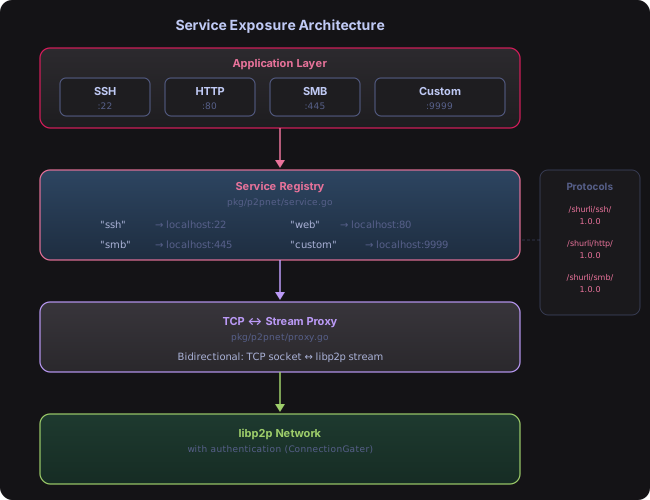
Service Exposure Architecture
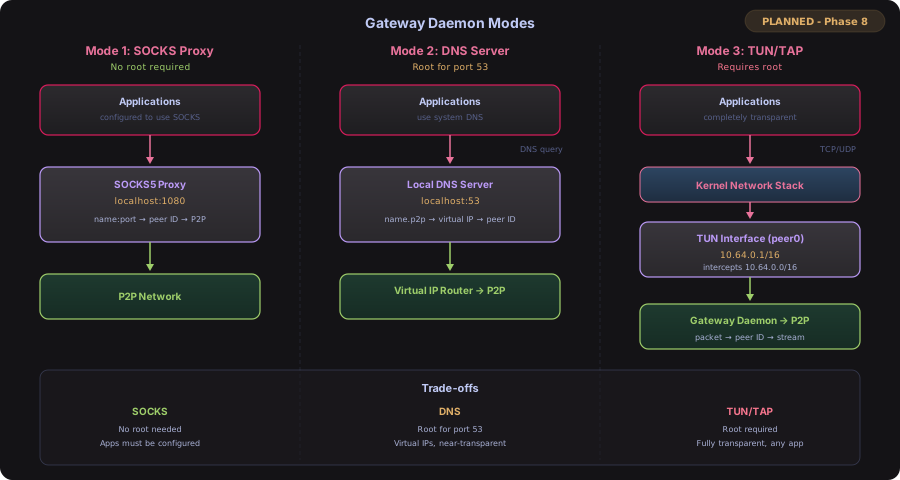
Gateway Daemon Modes
Status: Planned (Phase 11) - not yet implemented. See Roadmap Phase 12 for details.
Daemon Architecture
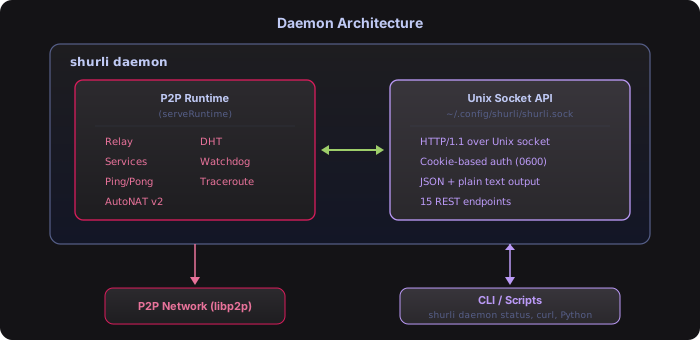
shurli daemon is the single command for running a P2P host. It starts the full P2P lifecycle plus a Unix domain socket API for programmatic control (zero overhead if unused - it’s just a listener).
Shared P2P Runtime
To avoid code duplication, the P2P lifecycle is extracted into serve_common.go:
// serveRuntime holds the shared P2P lifecycle state.
type serveRuntime struct {
    network          *sdk.Network
    config           *config.HomeNodeConfig
    configFile       string
    gater            *auth.AuthorizedPeerGater // nil if gating disabled
    authKeys         string                    // path to authorized_keys
    ctx              context.Context
    cancel           context.CancelFunc
    version          string
    startTime        time.Time
    kdht             *dht.IpfsDHT             // peer discovery from daemon API
    ifSummary        *sdk.InterfaceSummary  // interface discovery (IPv4/IPv6)
    pathDialer       *sdk.PathDialer        // parallel dial racing
    pathTracker      *sdk.PathTracker       // per-peer path quality tracking
    stunProber       *sdk.STUNProber        // NAT type detection
    mdnsDiscovery    *sdk.MDNSDiscovery     // LAN discovery (nil when disabled)
    peerManager      *sdk.PeerManager       // background reconnection with backoff
    netIntel         *sdk.NetIntel          // presence protocol (nil when disabled)
    peerRelay        *sdk.PeerRelay         // auto-enabled with public IP
    relayDiscovery   *sdk.RelayDiscovery    // static + DHT relay discovery
    metrics          *sdk.Metrics           // nil when telemetry disabled
    bwTracker        *sdk.BandwidthTracker  // per-peer bandwidth stats
    relayHealth      *sdk.RelayHealth       // EWMA relay health scoring
    peerHistory      *reputation.PeerHistory   // per-peer interaction tracking
}
Methods: newServeRuntime(), Bootstrap(), ExposeConfiguredServices(), SetupPingPong(), StartWatchdog(), StartStatusPrinter(), Shutdown().
Daemon Server
The daemon server (internal/daemon/) is decoupled from the CLI via the RuntimeInfo interface:
type RuntimeInfo interface {
    Network() *sdk.Network
    ConfigFile() string
    AuthKeysPath() string
    GaterForHotReload() GaterReloader            // nil if gating disabled
    Version() string
    StartTime() time.Time
    PingProtocolID() string
    ConnectToPeer(ctx context.Context, peerID peer.ID) error
    Interfaces() *sdk.InterfaceSummary        // nil before discovery
    PathTracker() *sdk.PathTracker             // nil before bootstrap
    STUNResult() *sdk.STUNResult               // nil before probe
    IsRelaying() bool                             // true if peer relay enabled
}
The serveRuntime struct implements this interface in cmd_daemon.go, keeping the daemon package importable without depending on CLI code.
Cookie-Based Authentication
Every API request requires Authorization: Bearer <token>. The token is a 32-byte random hex string written to ~/.shurli/.daemon-cookie with 0600 permissions. This follows the Bitcoin Core / Docker pattern - no plaintext passwords in config, token rotates on restart, same-user access only.
Stale Socket Detection
No PID files. On startup, the daemon dials the existing socket:
- Connection succeeds → another daemon is alive → return error
- Connection fails → stale socket from a crash → remove and proceed
Unix Socket API
38 HTTP endpoints over Unix domain socket. Every endpoint supports JSON (default) and plain text (?format=text or Accept: text/plain). Full API reference in Daemon API.
Dynamic Proxy Management
The daemon tracks active TCP proxies in memory. Scripts can create proxies via POST /v1/connect and tear them down via DELETE /v1/connect/{id}. All proxies are cleaned up on daemon shutdown.
Auth Hot-Reload
POST /v1/auth and DELETE /v1/auth/{peer_id} modify the authorized_keys file and immediately reload the connection gater via the GaterReloader interface. Access grants and revocations take effect without restart.
Concurrency Model
Background goroutines follow a consistent pattern for lifecycle management:
Ticker + Select Pattern
All recurring background tasks (relay reservation, DHT advertising, status printing, stats logging) use time.Ticker with select on ctx.Done():
go func() {
    ticker := time.NewTicker(interval)
    defer ticker.Stop()
    for {
        select {
        case <-ctx.Done():
            return
        case <-ticker.C:
            // do work
        }
    }
}()
This ensures goroutines exit cleanly when the parent context is cancelled (e.g., on Ctrl+C).
Watchdog + sd_notify
Both shurli daemon and shurli relay serve run a watchdog goroutine (internal/watchdog) that performs health checks every 30 seconds:
- shurli daemon: Checks host has listen addresses, relay reservation is active, and Unix socket is responsive
- shurli relay serve: Checks host has listen addresses and protocols are registered
On success, sends WATCHDOG=1 to systemd via the NOTIFY_SOCKET unix datagram socket (pure Go, no CGo). On non-systemd systems (macOS), all sd_notify calls are no-ops. READY=1 is sent after startup completes; STOPPING=1 on shutdown.
The systemd service uses Type=notify and WatchdogSec=90 (3x the 30s check interval) so systemd will restart the process if health checks stop succeeding.
Health Check HTTP Endpoint (/healthz)
The relay server optionally exposes a /healthz HTTP endpoint for external monitoring (Prometheus, UptimeKuma, etc.). Disabled by default in config:
health:
  enabled: true
  listen_address: "127.0.0.1:9090"
The endpoint returns JSON with: status, peer_id, version, uptime_seconds, connected_peers, protocols. Bound to localhost by default - not exposed to the internet. The HTTP server starts after the relay service is up and shuts down gracefully on SIGTERM.
Commit-Confirmed Enforcement
When a commit-confirmed is active (shurli config apply --confirm-timeout), serve starts an EnforceCommitConfirmed goroutine that waits for the deadline. If shurli config confirm is not run before the timer fires, the goroutine reverts the config and calls os.Exit(1). Systemd then restarts the process with the restored config.
Graceful Shutdown
Long-running commands (daemon, proxy, relay serve) handle SIGINT/SIGTERM by calling cancel() on their root context, which propagates to all background goroutines. The daemon also accepts shutdown requests via the API (POST /v1/shutdown). Deferred cleanup (net.Close(), listener.Close(), socket/cookie removal) runs after goroutines stop.
Atomic Counters
Shared counters accessed by concurrent goroutines (e.g., bootstrap peer count) use atomic.Int32 instead of bare int to prevent data races.
Observability (Batch H)
Status: Implemented - opt-in Prometheus metrics + structured audit logging.

All observability features are disabled by default and opt-in via config:
telemetry:
  metrics:
    enabled: true
    listen_address: "127.0.0.1:9091"
  audit:
    enabled: true
Prometheus Metrics (pkg/sdk/metrics.go): Uses an isolated prometheus.Registry (not the global default) for testability and collision-free operation. When enabled, libp2p.PrometheusRegisterer(reg) exposes all built-in libp2p metrics (swarm, holepunch, autonat, rcmgr, relay) alongside custom shurli metrics. When disabled, libp2p.DisableMetrics() is called for zero CPU overhead.
Custom shurli metrics (50 total):
shurli_proxy_bytes_total{direction, service}- bytes transferred through proxyshurli_proxy_connections_total{service}- proxy connections establishedshurli_proxy_active_connections{service}- currently active proxy sessionsshurli_proxy_duration_seconds{service}- proxy session durationshurli_auth_decisions_total{decision}- auth allow/deny countsshurli_holepunch_total{result}- hole punch success/failureshurli_holepunch_duration_seconds{result}- hole punch timingshurli_daemon_requests_total{method, path, status}- API request countsshurli_daemon_request_duration_seconds{method, path, status}- API latencyshurli_path_dial_total{path_type, result}- path dial attemptsshurli_path_dial_duration_seconds{path_type}- path dial timingshurli_connected_peers{path_type, transport, ip_version}- connected peer countshurli_network_change_total{change_type}- network interface changesshurli_stun_probe_total{result}- STUN probe resultsshurli_mdns_discovered_total{result}- mDNS discovery eventsshurli_peermanager_reconnect_total{result}- reconnection attemptsshurli_netintel_sent_total{result}- presence announcements sentshurli_netintel_received_total{result}- presence announcements receivedshurli_interface_count{ip_version}- network interface countshurli_vault_sealed- vault seal state (1=sealed, 0=unsealed)shurli_vault_seal_operations_total{trigger}- seal/unseal transitions by triggershurli_vault_unseal_total{result}- remote unseal attempts (success/failure/denied/blocked/locked_out/error)shurli_vault_unseal_locked_peers- peers currently in lockout or permanently blockedshurli_deposit_operations_total{operation}- invite deposit lifecycle (create/revoke/modify)shurli_deposit_pending- pending unconsumed depositsshurli_pairing_total{result}- relay-mediated pairing attemptsshurli_macaroon_verify_total{result}- macaroon token verificationsshurli_admin_request_total{endpoint, status}- admin socket request countsshurli_admin_request_duration_seconds{endpoint}- admin socket latencyshurli_info{version, go_version}- build informationshurli_zkp_prove_total- ZKP proof generation attemptsshurli_zkp_prove_duration_seconds- ZKP proof generation timingshurli_zkp_verify_total- ZKP proof verification attemptsshurli_zkp_verify_duration_seconds- ZKP proof verification timingshurli_zkp_auth_total- ZKP auth protocol attemptsshurli_zkp_tree_rebuild_total- Merkle tree rebuild countshurli_zkp_tree_rebuild_duration_seconds- Merkle tree rebuild timingshurli_zkp_tree_leaves- current Merkle tree leaf countshurli_zkp_challenges_pending- active challenge noncesshurli_zkp_range_prove_total- range proof generation attemptsshurli_zkp_range_prove_duration_seconds- range proof generation timingshurli_zkp_range_verify_total- range proof verification attemptsshurli_zkp_range_verify_duration_seconds- range proof verification timingshurli_zkp_anon_announcements_total- anonymous NetIntel announcements
Audit Logger (pkg/sdk/audit.go): Structured JSON events via log/slog with an audit group. All methods are nil-safe (no-op when audit is disabled). Events: auth decisions, service ACL denials, daemon API access, auth changes.
Daemon Middleware (internal/daemon/middleware.go): Wraps the HTTP handler chain (outside auth middleware) to capture request timing and status codes. Path parameters are sanitized (e.g., /v1/auth/12D3KooW... becomes /v1/auth/:id) to prevent high cardinality in metrics labels.
Auth Decision Callback: Uses a callback pattern (auth.AuthDecisionFunc) to decouple internal/auth from pkg/sdk, avoiding circular imports. The callback is wired in serve_common.go to feed both metrics counters and audit events.
Relay Metrics: When both health and metrics are enabled on the relay, /metrics is added to the existing /healthz HTTP mux. When only metrics is enabled, a dedicated HTTP server is started.
Grafana Dashboard: A pre-built dashboard (grafana/shurli-dashboard.json) ships with the project. Import it into any Grafana instance to visualize proxy throughput, auth decisions, vault unseal attempts, hole punch success rates, API latency, ZKP operations, and system metrics. 56 panels (45 visualizations + 11 row headers) across 11 sections: Overview, Proxy Throughput, Security, Hole Punch, Daemon API, System, ZKP Privacy, ZKP Auth Overview, ZKP Proof Generation, ZKP Verification, and ZKP Tree Operations.
Reference: pkg/sdk/metrics.go, pkg/sdk/audit.go, internal/daemon/middleware.go, cmd/shurli/serve_common.go, grafana/shurli-dashboard.json
Adaptive Path Selection (Batch I)
Status: Implemented - interface discovery, parallel dial racing, path tracking, network change monitoring, STUN probing, every-peer-is-a-relay.
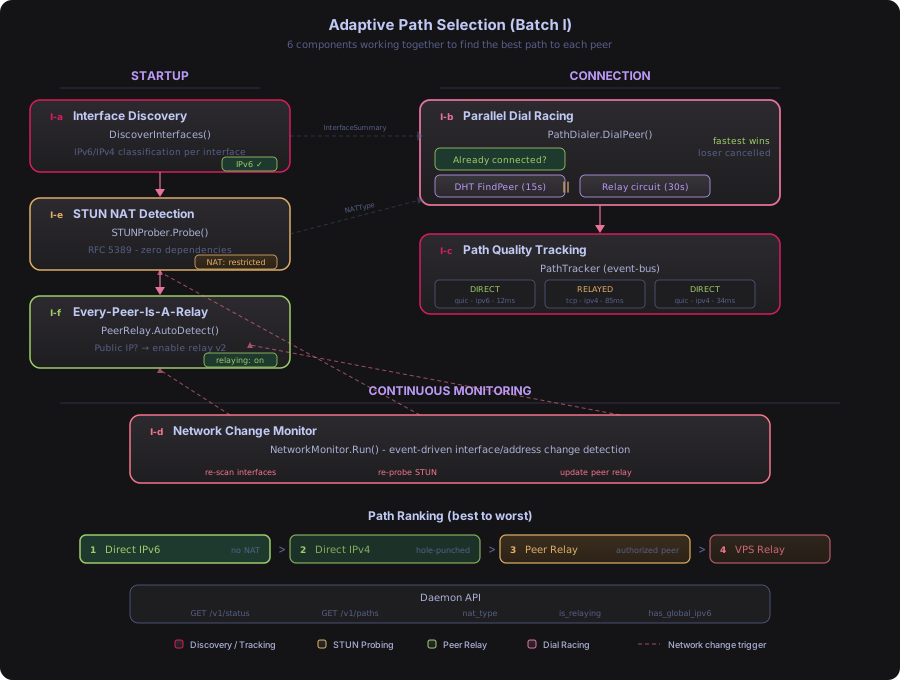
Six components work together to find and maintain the best connection path to each peer:
Interface Discovery (pkg/sdk/interfaces.go): DiscoverInterfaces() enumerates all network interfaces and classifies addresses as global IPv4, global IPv6, or loopback. Returns an InterfaceSummary with convenience flags (HasGlobalIPv6, HasGlobalIPv4). Called at startup and on every network change.
Parallel Dial Racing (pkg/sdk/pathdialer.go): PathDialer.DialPeer() replaces the old sequential connect (DHT 15s then relay 30s = 45s worst case) with parallel racing. If the peer is already connected, returns immediately. Otherwise fires DHT and relay strategies concurrently; first success wins, loser is cancelled. Classifies winning path as DIRECT or RELAYED based on multiaddr inspection.
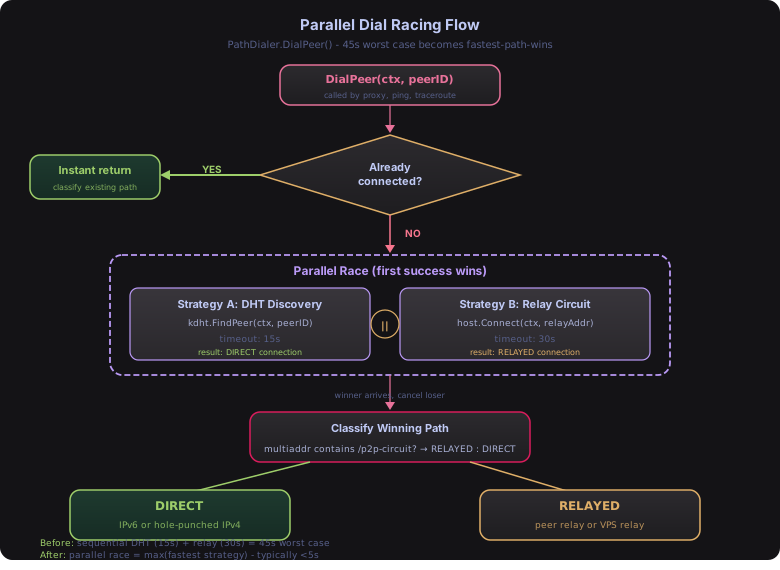
Path Quality Tracking (pkg/sdk/pathtracker.go): PathTracker subscribes to libp2p’s event bus (EvtPeerConnectednessChanged) for connect/disconnect events. Maintains per-peer path info: path type, transport (quic/tcp), IP version, connected time, last RTT. Exposed via GET /v1/paths daemon API. Prometheus labels: path_type, transport, ip_version.
Network Change Monitoring (pkg/sdk/netmonitor.go, netmonitor_darwin.go, netmonitor_linux.go): Event-driven on macOS (BSD route socket) and Linux (Netlink), polling fallback on other platforms. Detects three types of changes: global IP address changes, VPN tunnel interface appearance/disappearance, and default gateway changes (private IPv4 network switches). On change, fires the full recovery chain: strip stale LAN addresses, reset black hole detectors, clear dial backoffs, close stale connections, trigger reconnect, re-browse mDNS.
STUN NAT Detection (pkg/sdk/stunprober.go): Zero-dependency RFC 5389 STUN client. Probes multiple STUN servers concurrently, collects external addresses, classifies NAT type (none, full-cone, address-restricted, port-restricted, symmetric). HolePunchable() indicates whether DCUtR hole-punching is likely to succeed. Runs in background at startup (non-blocking) and re-probes on network change.
Every-Peer-Is-A-Relay (pkg/sdk/peerrelay.go): Any peer with a detected global IP auto-enables circuit relay v2 with conservative resource limits (4 reservations, 16 circuits, 128KB/direction, 10min sessions). Uses the existing ConnectionGater for authorization (no new ACL needed). Auto-detects on startup and network changes. Disables when public IP is lost.
Path Ranking: direct IPv6 > direct IPv4 > STUN-punched > peer relay > VPS relay. If all paths fail, the system falls back to relay and tells the user honestly.
Post-Chaos Hardening (16 test cases, 11 root causes fixed, verified on real hardware):
Chaos testing on satellite WiFi, terrestrial WiFi, 5G hotspot, and USB LAN (with live network transitions between them) revealed race conditions in the dial path that don’t appear in unit tests. Key fixes:
| Fix | Problem | Solution |
|---|---|---|
| VPN tunnel detection | VPN activation adds utun/tun/wg interfaces that confuse address classification | Pattern matching on interface names; VPN addresses excluded from relay advertisement |
| Default gateway tracking | Switching between private IPv4 networks (WiFi A -> WiFi B) doesn’t change global IP but changes reachable peers | RTM_ADD/RTM_CHANGE monitoring on macOS route socket triggers full recovery chain |
| TCP readiness probe | After satellite WiFi switch, mDNS discovers peer but TCP connect times out (ARP not resolved, 60-80s settle time) | TCP probe before dial; if probe fails, schedule retry instead of caching the failure |
| Stale LAN address stripping | Old LAN addresses stay in peerstore after network switch, causing dials to wrong subnet | Strip all LAN addresses from peerstore on network change event |
| IPv6 QUIC wins over mDNS LAN | mDNS discovers peer on LAN but IPv6 QUIC connects first via longer path | mDNS upgrades direct-but-no-LAN connections to LAN, closes dead IPv6, strips non-LAN addrs |
| Dial cache poisoning | libp2p’s dial_sync caches failed dials; network change doesn’t invalidate cache | Clear swarm backoffs on network change via OnNetworkChange() |
| Grant-aware backoff reset | After relay grants access, client sits in backoff from previous failed dials | Relay pushes /shurli/grant-receipt/1.0.0 to client; client caches receipt and clears all backoffs |
Manual override: shurli reconnect <peer> [--json] clears dial backoff for a specific peer and forces immediate redial. Designed for AI agent control loops that need deterministic reconnection.
Reference: pkg/sdk/interfaces.go, pkg/sdk/pathdialer.go, pkg/sdk/pathtracker.go, pkg/sdk/netmonitor.go, pkg/sdk/stunprober.go, pkg/sdk/peerrelay.go, pkg/sdk/peermanager.go, cmd/shurli/serve_common.go
libp2p Upstream Overrides
Shurli overrides several default libp2p behaviors to handle real-world network transitions (WiFi switches, VPN activation, CGNAT migration). These are the places where Shurli’s behavior diverges from stock libp2p. Check these first when debugging dial or connection issues.
| Override | Default libp2p | Shurli Behavior | File |
|---|---|---|---|
| TCP dialer | reuseport / sharedTcp | Source-bound net.Dialer (IPv6 binds to global addr) | network.go |
| Black hole detector | Internal, no reset API | Custom instances with ResetBlackHoles() on network change | network.go |
| Autorelay backoff | 1 hour | 30 seconds | network.go |
| Autorelay minInterval | 30 seconds | 5 seconds (static relays return instantly) | network.go |
| Autorelay boot delay | 3 minutes / 4 candidates | 0 / 1 (known static relays, no discovery phase) | network.go |
| Reachability | autonat (dynamic) | ForceReachabilityPrivate always (permanent relay fallback) | serve_common.go |
| Address factory | Default route interface only | globalIPv6AddrsFactory (all interface IPv6) | network.go |
| mDNS | libp2p mdns wrapper | Custom: zeroconf + native DNS-SD browse | mdns.go |
| Route socket (macOS) | RTM_NEWADDR / RTM_DELADDR / RTM_IFINFO | Also RTM_ADD / RTM_DELETE / RTM_CHANGE (catches WiFi hotspot switches) | netmonitor_darwin.go |
| Network change detection | Global IP diff only | Also: VPN tunnel interface diff + default gateway diff | netmonitor.go, interfaces.go |
TCP source binding (sourceBindDialerForAddr): When overrideDialerForAddr is set on libp2p’s TcpTransport, it bypasses the default reuseport and sharedTcp dial paths entirely. Every outgoing TCP connection goes through our custom dialer function instead. For IPv4 destinations, this returns a plain net.Dialer (no source binding, no reuseport). For global IPv6 destinations, it returns a net.Dialer with LocalAddr set to the host’s discovered global IPv6 address, forcing the kernel to route through the real network interface. Without this, macOS VPN apps (Mullvad, ExpressVPN, ProtonVPN) create utun interfaces with default IPv6 routes that persist even after the VPN disconnects. These stale routes silently capture all unbound IPv6 traffic, causing TCP connects to go through a dead tunnel and fail. Source binding overrides the kernel’s route selection. The WithDialerForAddr option is a clean extension point in libp2p’s TCP transport - 25 lines of code, no fork needed, survives library upgrades.
Black hole detector reset: libp2p’s swarm includes a BlackHoleSuccessCounter for UDP and IPv6 that tracks dial success rates (default: N=100 attempts, MinSuccesses=5 required). When success rate drops below threshold, the detector enters Blocked state and refuses further dials of that type, allowing only 1 in N through as a probe. This is designed to avoid wasting resources on known-bad transports. The problem: after a network switch, the detector’s state is stale. A switch from CGNAT (IPv6 always fails) to a WiFi network with working IPv6 leaves the detector in Blocked state, rejecting valid IPv6 dials. Stock libp2p provides no API to reset the detector. Shurli creates custom BlackHoleSuccessCounter instances via libp2p.UDPBlackHoleSuccessCounter() and libp2p.IPv6BlackHoleSuccessCounter(), stores references on the Network struct, and exposes ResetBlackHoles(). This is called from the network change callback in serve_common.go before any reconnection attempt.
Autorelay tuning for static relays: libp2p’s autorelay subsystem (p2p/host/autorelay/relay_finder.go) is designed for DHT-discovered relay networks where candidates arrive asynchronously. Its defaults reflect this: backoff=1h (don’t retry failed relays aggressively), minInterval=30s (rate-limit peer source queries), bootDelay=3min (wait for enough candidates before connecting), minCandidates=4 (compare quality before selecting). For Shurli’s static relay configuration (known VPS addresses, hardcoded in config), all four defaults are wrong. The peer source function returns a fixed list (zero network cost, instant return). Shurli overrides: backoff=30s (relay reconnection within one rsvpRefreshInterval after network change), minInterval=5s (peer source can be queried frequently without cost), bootDelay=0 (no discovery phase - we know which relays we want), minCandidates=1 (connect to the first available relay immediately). The reconnection path after a network change: cleanupDisconnectedPeers fires on connection loss, triggers findNodes to re-query the peer source, new candidates appear within 5s, connectToRelay dials with 10s timeout, circuitv2.Reserve establishes the reservation. Total: ~5-10s from relay loss to relay restored.
ForceReachabilityPrivate: libp2p’s autonat subsystem dynamically classifies the host as “public” or “private” based on dial-back probes from other peers. When classified as “public”, autorelay drops relay reservations (the reasoning: “I’m publicly reachable, I don’t need a relay”). This creates a failure window on networks with public IPv6: the daemon has a global IPv6 address, autonat classifies it as public, autorelay drops the relay reservation. Then when the user switches to a CGNAT network (no public IP), autonat needs several minutes of failed probes to reclassify as “private” and re-request relay reservations. During this window, there is no relay fallback. ForceReachabilityPrivate forces autonat to always report “private” regardless of actual reachability. The daemon maintains relay reservations as a permanent fallback on every network, whether or not it has a public IP. The cost is one relay reservation per relay server - negligible compared to the reliability gain.
Dial worker deduplication workaround: libp2p’s p2p/net/swarm/dial_sync.go creates exactly one dial worker goroutine per peer. All concurrent DialPeer calls to the same peer share this single worker. The worker maintains a trackedDials map (dial_worker.go:215-237) that caches dial results per address. When a dial to an address completes (success or failure), the result is stored. Subsequent DialPeer calls that arrive while the worker is active get the cached result from a hashmap lookup - no actual network dial occurs. After a network switch, the following race can happen: PeerManager’s reconnect loop (or DHT, or autonat) dials the peer’s stale LAN IPv4 address. WiFi is still settling, the dial fails with “no route to host”. This error is cached in trackedDials. When mDNS discovers the peer on the new LAN and calls DialPeer, it joins the existing worker and gets the cached error instantly - never actually dials. Three-part fix: (1) PeerManager.StripPrivateAddrs() removes all private/LAN addresses (RFC 1918 + RFC 6598 CGNAT + ULA + loopback via isStaleOnNetworkChange()) from watched peers’ peerstore BEFORE triggering reconnect. Without stale addresses in the peerstore, no subsystem can poison the cache. mDNS re-populates addresses from fresh multicast discovery. (2) mDNS runs a TCP readiness probe (probeTCPReachable() with 3s timeout, 500ms retry intervals, own context) before calling DialPeer. This prevents mDNS from self-poisoning the cache if WiFi is settling. (3) scheduleRetry (10s backup) handles probe failure on first attempt. All three parts are required: removing any one re-opens the cache poisoning window from a different subsystem.
Network change detection: libp2p’s default network monitoring only diffs global IP address changes between snapshots. Shurli extends this with three additional detection methods, each addressing a blind spot:
VPN tunnel interface detection: Watches for interfaces matching
utun[0-9]+(macOS: WireGuard, IKEv2, LightWay, iCloud Private Relay),tun[0-9]+(Linux: OpenVPN, generic),wg[0-9]+(WireGuard),ppp[0-9]+(L2TP). VPN tunnels typically carry only private IPv4 (10.x, 100.64.x), invisible to the global IP diff. When a tunnel interface appears or disappears, a network change event fires regardless of global IP changes.Default gateway tracking: Platform-specific gateway detection (macOS:
/sbin/route -n get default, Linux:/sbin/ip route show default) runs on every network change check. When the default gateway IP changes, it means the host moved to a different network even if no global IPs changed. This catches switches between two CGNAT carriers (e.g., two mobile hotspots, both private IPv4 only, no IPv6). The gateway comparison only fires when the current gateway is non-empty (suppresses intermittent lookup failures) but allows empty-to-non-empty transitions (handles daemon boot without WiFi followed by WiFi connection).Route socket expansion (macOS): The BSD route socket (
AF_ROUTE) listener addsRTM_ADD,RTM_DELETE, andRTM_CHANGEmessage types alongside the originalRTM_NEWADDR,RTM_DELADDR, andRTM_IFINFO. WiFi hotspot switches on macOS generate route table changes (default route update) but may not generate individual address events when only private IPs change on the same interface. The route change messages catch these transitions. Events are debounced (500ms after the last event) to coalesce bursts from rapid routing table updates.
Core Concepts
1. Service Definition
Services are defined in configuration and registered at runtime:
type Service struct {
    Name         string   // "ssh", "web", etc.
    Protocol     string   // "/shurli/ssh/1.0.0"
    LocalAddress string   // "localhost:22"
    Enabled      bool     // Enable/disable
}

type ServiceRegistry struct {
    services map[string]*Service
    host     host.Host
}

func (r *ServiceRegistry) RegisterService(svc *Service) error {
    // Set up stream handler for this service's protocol
    r.host.SetStreamHandler(svc.Protocol, func(s network.Stream) {
        // 1. Authorize peer
        if !r.isAuthorized(s.Conn().RemotePeer(), svc.Name) {
            s.Close()
            return
        }

        // 2. Dial local service
        localConn, err := net.Dial("tcp", svc.LocalAddress)
        if err != nil {
            s.Close()
            return
        }

        // 3. Bidirectional proxy
        go io.Copy(s, localConn)
        io.Copy(localConn, s)
    })
}
2. Bidirectional TCP↔Stream Proxy
func ProxyStreamToTCP(stream network.Stream, tcpAddr string) error {
    // Connect to local TCP service
    tcpConn, err := net.Dial("tcp", tcpAddr)
    if err != nil {
        return err
    }
    defer tcpConn.Close()

    // Bidirectional copy
    errCh := make(chan error, 2)

    go func() {
        _, err := io.Copy(tcpConn, stream)
        errCh <- err
    }()

    go func() {
        _, err := io.Copy(stream, tcpConn)
        errCh <- err
    }()

    // Wait for either direction to finish
    return <-errCh
}
3. Name Resolution
Currently implemented: LocalFileResolver resolves friendly names (configured via shurli invite/shurli join or manual YAML) to peer IDs. Direct peer ID strings are always accepted as fallback.
type LocalFileResolver struct {
    names map[string]peer.ID
}

func (r *LocalFileResolver) Resolve(name string) (peer.ID, error) {
    if id, ok := r.names[name]; ok {
        return id, nil
    }
    return "", ErrNotFound
}
Planned (Phase 9/14): The
NameResolverinterface,DHTResolver, multi-tier chaining, and blockchain naming are planned extensions. See Naming System below and Roadmap Phase 14.
Security Model
Authentication Layers
Layer 1: Network Level (ConnectionGater)
- Executed during connection handshake
- Blocks unauthorized peers before any data exchange
- Fastest rejection (minimal resource usage)
Layer 2: Protocol Level (Stream Handler)
- Defense-in-depth validation
- Per-service authorization (optional)
- Can override global authorized_keys
Per-Service Authorization
Status: Implemented (Pre-Batch H)
Each service can optionally restrict access to specific peer IDs via allowed_peers. When set, only listed peers can connect to that service. When omitted (nil), all globally authorized peers can access it.
services:
  ssh:
    enabled: true
    local_address: "localhost:22"
    allowed_peers: ["12D3KooW..."]  # Only these peers can access SSH

  web:
    enabled: true
    local_address: "localhost:80"
    # No allowed_peers = all authorized peers can access
The ACL check runs in the stream handler before dialing the local TCP service, so rejected peers never trigger a connection to the backend.
Role-Based Access Control (Phase 6)
Status: Implemented
Three-tier access model for relay operations:
- Tier 0 (Relay Operator): Unix socket access. Full control via admin endpoints.
- Tier 1 (Network Admin): First peer paired with relay auto-promoted to
role=admin. Can create/revoke invites, unseal relay remotely. - Tier 2 (Member): Standard authorized peer. Can use relay services but cannot create invites (unless invite policy is
open).
Roles are stored as role=admin or role=member attributes in authorized_keys. The first peer paired with a relay is automatically promoted to admin if no admins exist.
Reference: internal/auth/roles.go, internal/auth/manage.go, internal/relay/pairing.go
Macaroon Capability Tokens (Phase 6)
Status: Implemented
HMAC-chain bearer tokens for invite permissions. Each caveat in the chain produces a new HMAC-SHA256 signature, making caveat removal cryptographically impossible.
Key properties:
- Attenuation-only: holders can add restrictions (caveats), never remove them
- Offline verification: any party with the root key can verify without network calls
- Compact: base64-encoded JSON, suitable for CLI and QR codes
Supported caveat types:
| Caveat | Purpose |
|---|---|
peer_id | Binds token to a specific peer |
service | Comma-separated allowed services |
group | Group scope |
action | Allowed actions (invite, connect, admin) |
peers_max | Max peers this token can onboard |
delegate | Legacy delegation flag |
delegate_to | Binds delegated token to recipient peer (multi-hop audit trail) |
max_delegations | Remaining delegation hops (0=blocked, N=limited, -1=unlimited) |
expires | RFC3339 timestamp expiry |
network | DHT namespace scope |
auto_refresh | Enables background token refresh |
max_refreshes | Total refresh budget |
max_refresh_duration | Absolute deadline for all refreshes |
Reference: internal/macaroon/macaroon.go, internal/macaroon/caveat.go
Per-Peer Data Access Grants
Status: Implemented (Phases A, R, B, C, D - all complete)
Time-limited, per-peer capability grants built on macaroon tokens. Admins control exactly which peers can access which services, for how long. The grant system is the primary authorization layer for plugin services - relay ACLs are defense-in-depth only.
Architectural finding that drove this design: In a multi-relay topology, relay-side ACLs alone are insufficient. A peer connected through a permissive relay bypasses a strict relay’s ACL entirely. Node-level enforcement is the true security boundary. See Security Thought Experiment for the full 20-vector analysis.
Two-sided model:
   Issuer (Node A)                           Holder (Peer B)
   +--------------+                          +-----------+
   | GrantStore   |  --- P2P delivery --->   | Pouch     |
   | (keyed by    |  <-- refresh request --- | (keyed by |
   |  grantee)    |  --- new token --------> |  issuer)  |
   +--------------+                          +-----------+
Grant Store (Issuer Side)
The admin’s grant registry. Creates macaroon tokens, stores them locally, enforces them at stream open time.
- Thread-safe, keyed by grantee peer ID
- Persisted to
grants.jsonwith HMAC-SHA256 integrity (key derived from node identity via HKDF) - Monotonic version counter prevents expired-grant replay via file restore
- Auto-cleanup of expired grants on configurable interval (default 30s)
- Callbacks on every mutation: P2P token delivery, connection closure on revoke, Phase C notifications, Phase D audit log
CLI commands:
| Command | Purpose |
|---|---|
shurli auth grant <peer> --duration 1h | Create time-limited grant |
shurli auth grant <peer> --duration 7d --services file-transfer,file-browse | Service-scoped grant |
shurli auth grant <peer> --permanent | Permanent grant (requires confirmation) |
shurli auth revoke <peer> | Immediate revocation + close all connections |
shurli auth extend <peer> --duration 2h | Extend from current time |
shurli auth grants | List all grants with remaining time |
shurli auth grant <peer> --auto-refresh --max-refreshes 3 | Auto-refreshing grant |
All commands support --json for AI agent integration (consistent {"status":"ok","data":{...}} envelope).
Reference: internal/grants/store.go
Grant Pouch (Holder Side)
The receiver’s token wallet. Stores macaroon tokens received from granting nodes.
- Thread-safe, keyed by issuing node’s peer ID
- Persisted to
grant_pouch.jsonwith HMAC-SHA256 integrity (separate HKDF sub-key) - Background cleanup removes expired entries
- Background refresh loop: at 10% remaining duration, requests fresh token from issuer
- Delegation support: creates attenuated sub-tokens with decremented hop count
CLI: shurli auth pouch [--json] shows held tokens with issuer, services, remaining time.
Reference: internal/grants/pouch.go
Token Presentation (Stream-Level)
Every plugin stream opens with a binary grant header. The holder presents their token; the node verifies it cryptographically.
Wire format (on every plugin stream open):
Byte 0:     Version (0x01)
Byte 1:     Flags (0x01 = has token, 0x00 = no token)
Bytes 2-3:  Token length (uint16 big-endian, max 8192)
Bytes 4-N: Base64-encoded macaroon token (only if flags & 0x01)- 4 bytes overhead when no token (stack-allocated fast path)
- 2-second read/write deadline prevents slowloris
- Token path: verify cryptographically with root key (no disk I/O)
- No-token path: falls back to local grant store lookup (Phase A behavior)
- Token presented on non-relay transport: logged but not required (relay transport is where grants matter)
- Constant-time rejection: HMAC work on all paths (valid, invalid, malformed) prevents timing oracles
Reference: pkg/sdk/grant_header.go
P2P Grant Delivery Protocol
Protocol: /shurli/grant/1.0.0
Wire messages (1-byte type + uint32 length + JSON payload, max 8192 bytes):
| Type | Direction | Purpose |
|---|---|---|
0x01 GrantDeliver | issuer -> peer | Token delivery |
0x02 GrantRevoke | issuer -> peer | Revocation notice |
0x03 GrantAck | peer -> issuer | Delivery acknowledgement |
0x04 GrantRefresh | peer -> issuer | Token refresh request |
- Trust check: only accepts deliveries/revocations from peers in authorized_keys
- Rate limit: 5 deliveries per minute per peer (protocol level)
- Offline queue: deliveries cached on granting node (not relay - sovereignty preserved), flushed on peer reconnect
- Queue TTL: configurable (default 7 days), max 100 items
- Stream timeout: 10 seconds
- Protocol version field on all messages (downgrade protection)
Token refresh: Peer’s daemon monitors approaching expiry (10% remaining). Sends refresh request. Issuer checks budget and deadline, issues fresh token. CLI shows effective max duration (e.g., “1h grant, 3 refreshes = 4h effective max duration”).
Reference: internal/grants/protocol.go, internal/grants/delivery_queue.go
Delegation
Multi-hop token attenuation. A granted peer can create restricted sub-tokens for other peers.
How it works:
- Admin grants Peer B with
--delegate 3(3 further hops allowed) - Peer B attenuates: adds
delegate_to=C+max_delegations=2caveats - Peer C presents the attenuated token to Admin’s node
- Admin verifies full HMAC chain with root key - valid because caveats can only be narrowed, never widened
Delegation modes:
| Mode | CLI Flag | Behavior |
|---|---|---|
| Disabled | --delegate 0 (default) | Token bound to this peer only |
| Limited | --delegate N | Up to N further hops, each delegation decrements |
| Unlimited | --delegate unlimited | Free re-sharing (still attenuation-only) |
CLI: shurli auth delegate <peer> --to <target> [--duration 10m] [--delegate 1]
The delegate_to caveat chain forms an audit trail: the original peer_id identifies who was first granted, each delegate_to identifies subsequent holders.
Reference: internal/macaroon/caveat.go (ExtractEarliestExpires, delegation verifier), internal/grants/pouch.go (Delegate method)
Notification Subsystem
Status: Implemented (Phase C)
Multi-channel event routing for grant lifecycle events. Designed for desktop admins, headless servers, mobile apps, and AI agent pipelines.
Architecture: NotificationSink interface with non-blocking dispatch.
type NotificationSink interface {
    Name() string
    Notify(event Event) error
}
Event types:
| Event | Severity | Trigger |
|---|---|---|
grant_created | info | New grant issued |
grant_expiring | warn | Pre-expiry warning (configurable threshold, default 10 min) |
grant_expired | warn | Token expired |
grant_revoked | warn | Grant revoked |
grant_extended | info | Duration extended |
grant_refreshed | info | Token refreshed |
grant_rate_limited | warn | Peer exceeded ops rate limit |
Built-in sinks:
| Sink | Description | Config |
|---|---|---|
| LogSink | Always on. Structured slog output. Audit trail baseline for log aggregators. | notifications.log_level |
| DesktopSink | macOS: osascript, Linux: notify-send. Auto-disabled on headless. | notifications.desktop: true |
| WebhookSink | HTTP POST JSON to configured URL. Retry with backoff. Event filter. | notifications.webhook.url |
WebhookSink is the universal integration point: Telegram bots, Slack, email services, n8n, custom AI agent endpoints all consume webhooks.
Router: Events dispatched to all sinks in goroutines (non-blocking). Sink failures/panics logged but never propagate. Dedup via event ID (5-minute TTL). Pre-expiry warning ticker runs at configurable interval.
AI agent pattern: Webhook delivers structured JSON events. Agent receives, acts (extend grants, alert admin), sends commands back via shurli auth extend --json. The grant audit trail captures both the notification and the response.
CLI: shurli notify test (send test event), shurli notify list (show configured sinks). shurli status includes notifications section.
Reference: internal/notify/router.go, internal/notify/event.go, internal/notify/sink_log.go, internal/notify/sink_desktop.go, internal/notify/sink_webhook.go
Integrity-Chained Audit Log
Status: Implemented (Phase D)
Append-only, tamper-evident grant operation log.
Each entry: HMAC-SHA256(key, prev_hash + entry_data). Breaking the chain at any point invalidates all downstream entries.
Events logged: grant_created, grant_revoked, grant_extended, grant_refreshed, grant_expired. Every Store mutation is captured.
CLI:
shurli auth audit- Read log directly (works without daemon)shurli auth audit --verify- Validate full chain integrityshurli auth audit --tail N- Show last N entries (default 20)
Security: Symlink rejection on write. Write + fsync before updating in-memory chain state (crash safety). Separate HKDF sub-key (shurli/grants/audit/v1).
Per-peer ops rate limiter: 10 operations per minute per peer (default). Separate from protocol-level rate limit. Fires grant_rate_limited notification on first violation per window.
Reference: internal/grants/audit.go, internal/grants/rate_limit.go
Grant-Aware Backoff Reset
When the relay creates or extends a grant, it pushes a grant receipt via /shurli/grant-receipt/1.0.0. The client caches the receipt and calls OnNetworkChange() to clear all swarm backoffs, enabling immediate reconnection without waiting for exponential backoff timers. See Grant Receipt Protocol for full details.
Manual override: shurli reconnect <peer> [--json] clears dial backoff for a specific peer and forces an immediate redial. Designed for AI agent control loops.
Reference: pkg/sdk/peermanager.go
Grant Receipt Protocol
Protocol: /shurli/grant-receipt/1.0.0
Carries a full 62-byte receipt with grant parameters. The relay pushes a receipt to the peer whenever a grant is created, extended, or the peer reconnects.
Wire format (62 bytes):
| Offset | Size | Field | Description |
|---|---|---|---|
| 0 | 1 | version | 0x01 |
| 1 | 8 BE | grant_duration_secs | Relative duration (0 for permanent grants) |
| 9 | 8 BE | session_data_limit | Bytes per direction per session (0 = unlimited) |
| 17 | 4 BE | session_duration_secs | Per-circuit session duration |
| 21 | 1 | permanent | 0x00 = no, 0x01 = yes |
| 22 | 8 BE | issued_at | Unix seconds (relay clock) |
| 30 | 32 | HMAC-SHA256 | Over canonical payload (first 30 bytes) |
The HMAC key is derived via HKDF from the relay’s identity with context "grant-receipt/v1". Clients store the HMAC for future verification but do not verify it locally today (no shared key). The issued_at field enables stale-revocation detection: a revocation older than the current cached receipt is ignored.
Client-side GrantCache (internal/grants/cache.go):
- Keyed by relay peer ID. One receipt per relay.
- Thread-safe (
sync.RWMutex). Persisted to~/.shurli/grant_cache.jsonwith HMAC-SHA256 integrity (key derived from client identity via HKDF with context"grant-cache/v1"). - Symlink rejection on write (defense-in-depth). Max file size check on load (1 MB).
- Per-circuit byte counters (
CircuitBytesSent,CircuitBytesReceived) track session budget usage. These are in-memory only (not persisted) and reset on new circuit. - Background cleanup goroutine removes expired entries on a configurable interval.
GrantStatus()satisfies theRelayGrantCheckerinterface via structural typing (no import cycle).
Smart pre-transfer checks (plugins/filetransfer/transfer_grants.go):
Before a relay-mediated file transfer, the transfer service checks the cached receipt:
- Budget check: is the remaining session budget (per direction) sufficient for the file size?
- Time check: is the grant remaining time (and session duration) sufficient for the estimated transfer time at a conservative 200 KB/s?
- If budget is insufficient, the transfer service establishes a new circuit (resetting session counters) and retries.
- If the transfer fails mid-stream and the grant is still active, smart reconnection retries with exponential backoff (2s initial, 32s max, 5 attempts). Application-level errors (rejection, file errors, access denied) are excluded from retry.
Per-chunk byte tracking: every chunk written to a relayed stream increments the circuit byte counter via TrackCircuitBytes(), clamped to MaxInt64 to prevent overflow.
Relay-side push (internal/relay/grant_receipt.go):
NotifyGrantReceipt()encodes and sends a receipt to a connected peer. If the peer is offline, delivery is deferred to reconnect.sendGrantReceipt()sends pre-encoded receipt bytes to a connected peer viaGrantReceiptProtocol.RunReconnectNotifier()pushes receipts to peers with active grants on reconnection (viaEvtPeerIdentificationCompleted).
Client-side handler (cmd/shurli/serve_common.go):
- Registers stream handlers for both protocols.
- Receipt handler: validates sender is a configured relay, rate limits (max 1 per relay per 10s), reads 62 bytes with 5s deadline, decodes, checks clock drift (warns if >60s), caches the receipt, then clears dial backoffs.
- Legacy handler: clears dial backoffs only (same behavior as before the protocol upgrade).
CLI visibility (shurli status):
The Relay Grants: section in shurli status displays per-relay grant info from the cache. See the Commands reference for output format details.
Backward compatibility:
- Relays running the new code send receipts to new clients and 1-byte signals to old clients (protocol negotiation).
- New clients with old relays never receive receipts (no handler registered on the relay). The cache stays empty and pre-transfer checks are skipped (graceful degradation).
Reference: internal/relay/grant_receipt.go, internal/grants/cache.go, plugins/filetransfer/transfer_grants.go, cmd/shurli/serve_common.go
Security Thought Experiment
20 attack vectors analyzed across 5 categories before implementation. All mitigated.
| # | Finding | Risk | Mitigation |
|---|---|---|---|
| C2 | Multi-relay bypass: relay ACL alone is insufficient | CRITICAL | Node-level enforcement is the true security boundary |
| A1 | Grant store tampering | HIGH | HMAC-SHA256 with node-derived key |
| B1 | Active transfers survive grant expiry | HIGH | 30s re-verify interval during transfers |
| C1 | Service restrictions not enforced per-stream | HIGH | Every stream handler verifies grant independently |
| E1 | Share peer list implicitly grants data access | HIGH | Share membership and data grants are separate decisions |
| C3 | Active circuits survive revocation | MEDIUM | ClosePeer on revoke terminates all connections |
| B2/B3 | Concurrent modification races | MEDIUM | In-memory mutex (single daemon per node) |
| A2 | Symlink race on grant store | MEDIUM | Lstat check, reject symlinks on write |
| D2 | Log injection via peer name | MEDIUM | Structured logging with sanitized fields |
| D3 | Log tampering hides audit trail | MEDIUM | Integrity-chained append-only logs (Phase D) |
| D1 | Timing oracle on grant state | LOW | Constant-time rejection on all deny paths |
| B4 | Rapid grant-revoke confused state | LOW | Per-peer ops rate limiter (Phase D) |
| E4 | Permission fatigue (social engineering) | LOW | Short default duration, confirmation for permanent |
The critical architectural finding (C2) is the reason the grant system exists at the node level rather than extending relay ACLs. In a multi-relay topology, the node is the only enforcement point that sees all traffic regardless of relay path.
Passphrase-Sealed Vault (Phase 6)
Status: Implemented
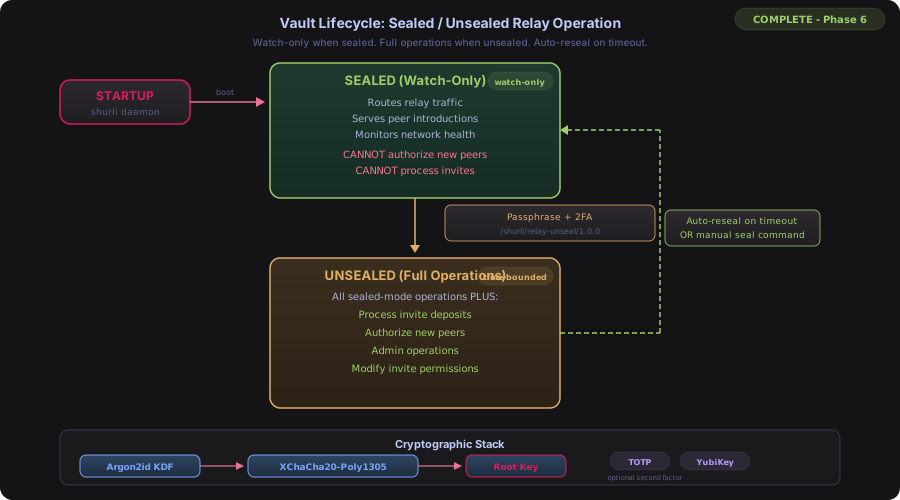
The relay’s root key material (used for macaroon minting) is protected by a passphrase-sealed vault. Two operational modes:
Sealed (default after restart):
- Routes circuit relay traffic for existing peers
- Serves existing peer introductions
- Cannot authorize new peers or process invite deposits
Unsealed (time-bounded):
- All sealed-mode operations plus new peer authorization
- Processes invite deposits and join requests
- Auto-reseals after configurable timeout
Crypto stack:
- KDF: Argon2id (time=3, memory=64MB, threads=4, keyLen=32)
- Encryption: XChaCha20-Poly1305
- 2FA: TOTP (RFC 6238) and/or Yubikey HMAC-SHA1
Seed recovery: hex-encoded 32-byte root key (24 words). Reconstructs vault with new passphrase.
Remote unseal: /shurli/relay-unseal/1.0.0 P2P protocol. Admin-only (role check), iOS-style escalating lockout (4 free attempts, then 1m/5m/15m/1h, permanent block). Prometheus metrics: shurli_vault_sealed, shurli_vault_seal_operations_total{trigger}, shurli_vault_unseal_total{result}, shurli_vault_unseal_locked_peers.
Reference: internal/vault/vault.go, internal/relay/unseal.go, internal/totp/totp.go, internal/yubikey/challenge.go
Async Invite Deposits (Phase 6)
Status: Implemented
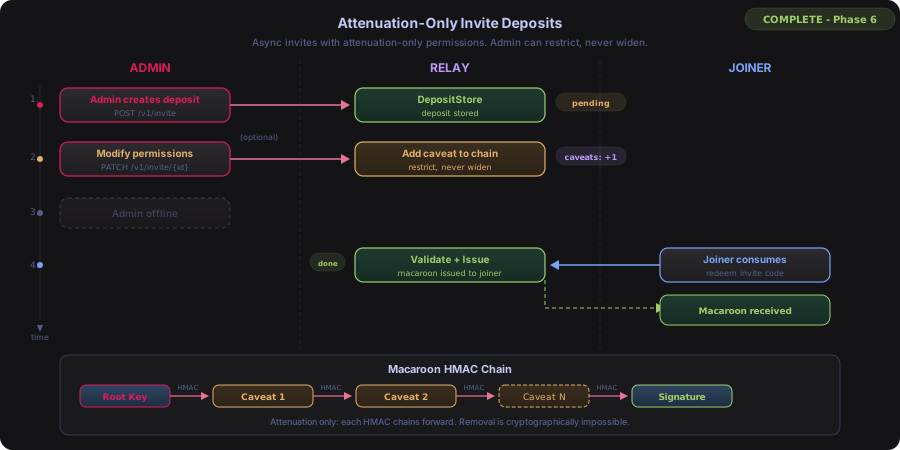
Client-deposit invites (“contact card” model). Admin creates an invite deposit on the relay and walks away. The joining peer consumes it later, without the admin needing to be online.
Attenuation-only model: the invite code is the authentication (immutable token). Permissions are mutable caveats on the deposit macaroon. Admins can restrict or revoke before consumption, but can never widen permissions (HMAC chain enforces this cryptographically).
Deposit states: pending -> consumed | revoked | expired
Relay admin endpoints: POST /v1/invite (create), GET /v1/invite (list), DELETE /v1/invite/{id} (revoke), PATCH /v1/invite/{id} (add caveats), POST /v1/auth/reload (hot-reload authorized_keys + ZKP tree). See also Anonymous Relay Authorization (Phase 7) for ZKP endpoints: POST /v1/zkp/tree-rebuild, GET /v1/zkp/tree-info, GET /v1/zkp/proving-key, GET /v1/zkp/verifying-key.
Reference: internal/deposit/store.go, cmd/shurli/cmd_relay_invite.go
ZKP Privacy Layer (Phase 7)
Status: Implemented
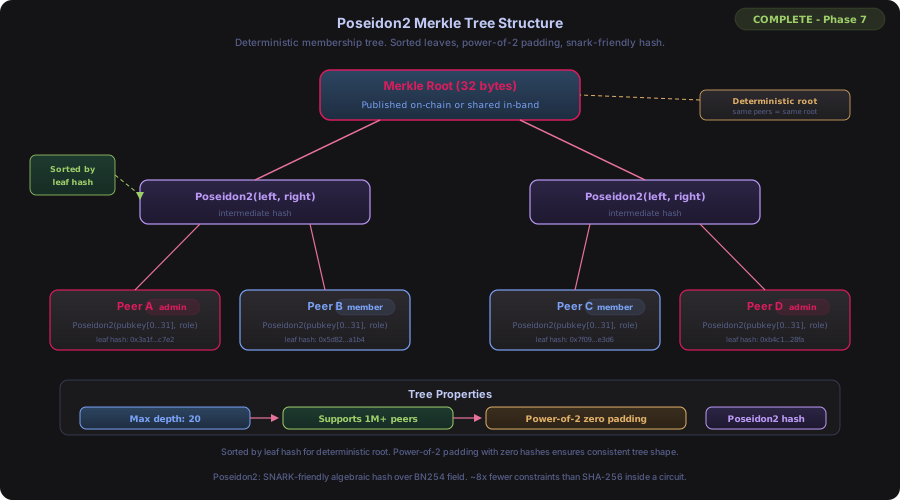
Zero-knowledge proof system for anonymous authentication. Peers prove “I’m in the authorized set” without the relay learning which peer they are. Built on gnark v0.14.0 PLONK with BN254 curve.
Core primitive: A Poseidon2 Merkle tree of authorized peer keys. Each leaf is Poseidon2(ed25519_pubkey[0..31], role_encoding, score) - 34 field elements. Leaves sorted by hash, padded to next power of 2, max depth 20 (supports 1M+ peers).
Membership circuit (22,784 SCS constraints):
- Public inputs: MerkleRoot, Nonce (replay protection), RoleRequired
- Private inputs: PubKeyBytes[32], RoleEncoding, Score, Path[20], PathBits[20]
- Constraints: Poseidon2 leaf hash (34 elements), 20-level Merkle path walk, root assertion, conditional role check, nonce binding
- 520-byte proofs, ~1.8s prove, ~2-3ms verify
Key management: Proving key (~2 MB) and verifying key (~33.5 KB) cached to disk. Circuit recompiled on demand (~70ms) - gnark’s CCS CBOR deserialization panics on Go 1.26, so serialization is deliberately avoided.
Dependencies: gnark v0.14.0, gnark-crypto v0.19.0 (pure Go, no CGo).
Reference: internal/zkp/poseidon2.go, internal/zkp/merkle.go, internal/zkp/membership.go, internal/zkp/prover.go, internal/zkp/verifier.go, internal/zkp/keys.go, internal/zkp/srs.go
Anonymous Relay Authorization (Phase 7)
Status: Implemented
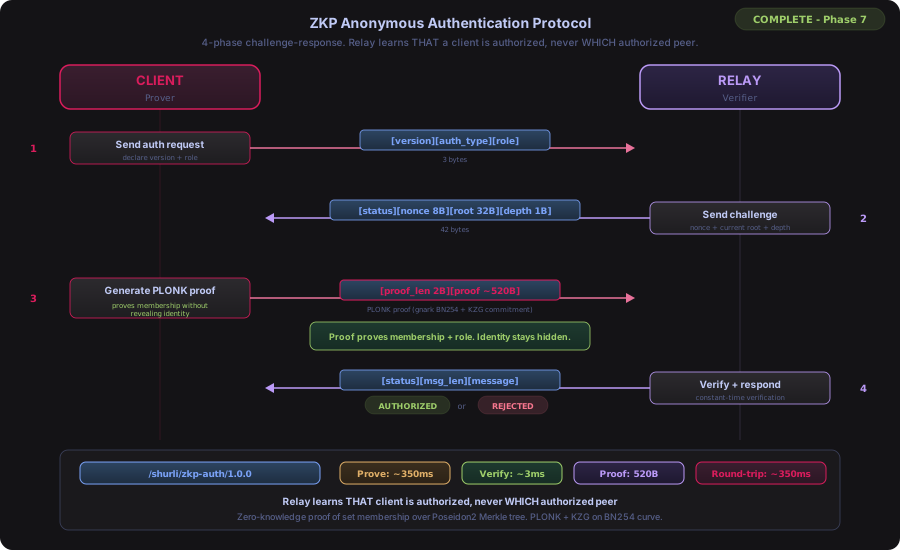
Challenge-response protocol for anonymous relay authentication. Binary wire format on libp2p streams.
Protocol: /shurli/zkp-auth/1.0.0
CLIENT -> RELAY:  [1 version] [1 auth_type] [1 role_required]     (3 bytes)
RELAY  -> CLIENT: [1 status] [8 nonce BE] [32 root] [1 depth]     (42 bytes)
CLIENT -> RELAY:  [2 BE proof_len] [N proof_bytes]                 (~522 bytes)
RELAY  -> CLIENT: [1 status] [1 msg_len] [N message]               (variable)
Auth types: 0x01 membership (any authorized peer), 0x02 role (specific role). Nonces are cryptographically random uint64, single-use, 30-second TTL.
Admin endpoints (relay Unix socket):
POST /v1/zkp/tree-rebuild- rebuild Merkle tree from authorized_keys (vault-gated)GET /v1/zkp/tree-info- current tree state (always available)GET /v1/zkp/proving-key- download proving key binary (~2 MB)GET /v1/zkp/verifying-key- download verifying key binary (~34 KB)
Prometheus metrics (9 new): shurli_zkp_prove_total, shurli_zkp_prove_duration_seconds, shurli_zkp_verify_total, shurli_zkp_verify_duration_seconds, shurli_zkp_auth_total, shurli_zkp_tree_rebuild_total, shurli_zkp_tree_rebuild_duration_seconds, shurli_zkp_tree_leaves, shurli_zkp_challenges_pending.
Reference: internal/relay/zkp_auth.go, internal/relay/zkp_client.go, internal/zkp/challenge.go
Private Reputation (Phase 7)
Status: Implemented
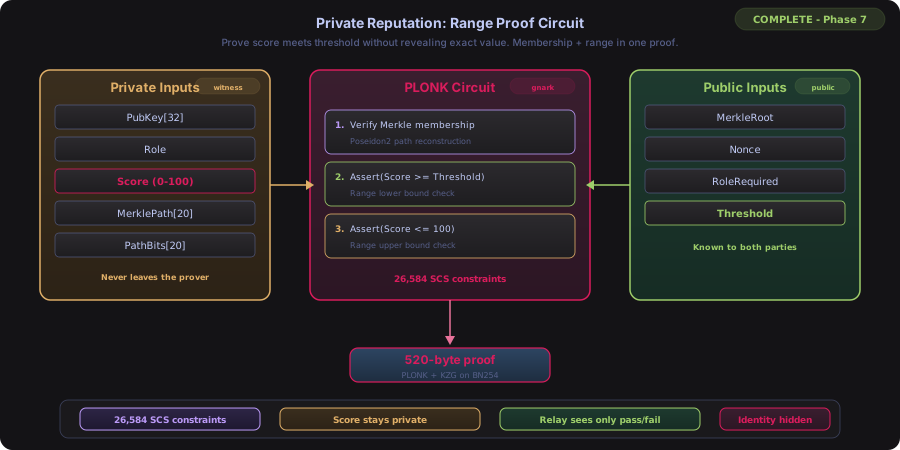
Range proofs on peer reputation scores. Prove “my score is above threshold X” without revealing the exact score.
Scoring formula (ComputeScore returns 0-100, four equally-weighted components):
- Availability (0-25): ConnectionCount / maxConnections, linear
- Latency (0-25): logarithmic decay from 10ms (25) to 5000ms (0)
- PathDiversity (0-25): 0 types=0, 1=8, 2=16, 3+=25
- Tenure (0-25): days since FirstSeen / 365, capped at 1.0
Range proof circuit (27,004 SCS constraints):
- Extends membership circuit with
Score(private, committed in leaf) andThreshold(public) - Additional constraints:
Score >= Threshold,Score <= 100 - Same 520-byte proofs, separate PLONK keys
Trust model: Score is committed in the Merkle tree leaf hash alongside pubkey and role. The range proof circuit verifies the same score value used in the leaf hash, preventing inflation.
Anonymous NetIntel: NodeAnnouncement has AnonymousMode bool and ZKPProof []byte fields. When anonymous, From is empty, proof substitutes for identity.
Prometheus metrics (5 new): shurli_zkp_range_prove_total, shurli_zkp_range_prove_duration_seconds, shurli_zkp_range_verify_total, shurli_zkp_range_verify_duration_seconds, shurli_zkp_anon_announcements_total.
RLN extension point: RLNIdentity, RLNProof, RLNVerifier interface defined (types only, no circuit). Composable with existing membership proof for future anonymous rate limiting.
Reference: internal/reputation/score.go, internal/zkp/range_proof.go, internal/zkp/rln_seam.go, pkg/sdk/netintel.go
BIP39 Key Management (Phase 7)
Status: Implemented
Deterministic PLONK key generation from BIP39 seed phrases. One seed per node. Seeds never stored on disk.
Flow: SHA256(mnemonic) -> gnark WithToxicSeed -> deterministic SRS -> same proving/verifying keys on any machine.
CLI: shurli relay zkp-setup generates a 24-word BIP39 mnemonic, derives SRS, saves proving key and verifying key. --seed flag accepts existing mnemonic for deterministic reproduction.
Key distribution: Clients download proving key and verifying key from relay via GET /v1/zkp/proving-key and GET /v1/zkp/verifying-key. No seed sharing between nodes.
Reference: internal/zkp/bip39.go, internal/zkp/srs.go, cmd/shurli/cmd_relay_zkp.go
Unified Seed Architecture (Phase 8)
Status: Implemented
ONE BIP39 seed phrase (24 words) derives all cryptographic material via HKDF domain separation. Same construction as Bitcoin HD wallets.
BIP39 Seed (24 words)           <-- ONE backup. Paper. Offline.
    |
    |-- HKDF(seed, "shurli/identity/v1")  --> Ed25519 private key --> Peer ID
    |                                          (encrypted with password on disk)
    |
    |-- HKDF(seed, "shurli/vault/v1")     --> Vault root key (relay only)
    |                                          (encrypted with vault password)
    |
    `-- SRS derivation from seed           --> ZKP proving/verifying keys (relay only)
                                               (cached as .bin files)
Security properties: Identity key and vault key are cryptographically independent (different HKDF domains). Only the seed can derive all key types. Seed is never stored on disk.
CLI: shurli init generates seed, confirms via quiz, derives identity. shurli recover reconstructs from seed. shurli recover --relay also recovers vault + ZKP keys.
Reference: internal/identity/seed.go
Encrypted Identity (Phase 8)
Status: Implemented
All nodes (not just relays) encrypt their identity key at rest using the SHRL format:
- KDF: Argon2id (time=1, memory=64MB, threads=4)
- Cipher: XChaCha20-Poly1305 (24-byte nonce)
- File format: SHRL magic header + version + Argon2id salt + nonce + ciphertext
The key is decrypted at daemon startup with the node password. Raw (unencrypted) identity.key files from older installations are detected and the user is prompted to encrypt.
CLI: shurli change-password re-encrypts with a new password. Session tokens allow password-free restarts.
Reference: internal/identity/encrypted.go
Remote Admin Protocol (Phase 8)
Status: Implemented
Full relay management over encrypted P2P connections using /shurli/relay-admin/1.0.0. All 28 relay admin API endpoints (pairing, vault, invites, ZKP, MOTD, goodbye) are accessible remotely from any admin peer.
Wire format: JSON-over-stream with request/response framing. The remote admin handler adapts P2P stream requests into HTTP requests against the local admin socket, then streams responses back.
Security: Admin role check at stream open (non-admins rejected before any data). Rate limiting (5 requests/second per peer). Same auth model as the local Unix socket.
CLI: All relay admin commands support --remote <addr> to operate remotely instead of through the local Unix socket. The relayAdminClientOrRemote() helper transparently selects the transport.
Reference: internal/relay/remote_admin.go, internal/relay/remote_admin_client.go, internal/relay/admin_api.go
MOTD and Goodbye (Phase 8)
Status: Implemented
Signed operator announcements using the /shurli/relay-motd/1.0.0 protocol.
Message types:
- MOTD (0x01): Short message shown to peers on connect. 280-char limit. Deduped per-relay (24h).
- Goodbye (0x02): Persistent farewell pushed to all connected peers immediately. Cached by clients, survives restarts. Used for planned relay decommission.
- Retract (0x03): Cancels a goodbye (relay is back).
Wire format: [1 version][1 type][2 BE msg-len][N msg][8 BE timestamp][Ed25519 signature]
Security: All messages signed by the relay’s Ed25519 identity key. Clients verify signatures before displaying. Messages sanitized by SanitizeRelayMessage(): URL stripping, email stripping, non-ASCII removal, 280-char truncation. Defense against prompt injection and phishing.
Goodbye lifecycle: relay goodbye set pushes to all peers. relay goodbye retract clears cached goodbyes. relay goodbye shutdown sends goodbye then triggers graceful relay shutdown with 2s delay for message delivery.
Reference: internal/relay/motd.go, internal/relay/motd_client.go, internal/validate/relay_message.go
Session Tokens (Phase 8)
Status: Implemented
Machine-bound session tokens that allow password-free daemon restarts. Same model as ssh-agent: enter password once, work until the token expires or is destroyed.
Design: Session token encrypts the identity key with a machine-derived key. Token is bound to the machine (hostname + machine ID) so copying it to another device does not work.
CLI: shurli session refresh rotates the token. shurli session destroy deletes it (password required on next start). shurli lock / shurli unlock gate sensitive operations without destroying the session.
Reference: internal/identity/session.go, cmd/shurli/cmd_lock.go
File Transfer (Phase 9B)
Status: Implemented - fully extracted to
plugins/filetransfer/as the first plugin. The plugin owns the entire protocol engine (TransferService, ShareRegistry, chunker, compression, erasure, multi-peer, checkpoint/resume) plus the integration layer (CLI commands, daemon handlers, P2P protocol registration). Generic utilities (MerkleRoot, transport classification) are imported frompkg/sdk/.
Chunked P2P file transfer with content-defined chunking, integrity verification, compression, erasure coding, multi-source download, parallel streams, and AirDrop-style receive permissions. Relay transport is allowed (relay-side bandwidth limits enforce conservation). Seven-layer DDoS defense protects all transfer endpoints.
Four P2P protocols:
| Protocol | Purpose |
|---|---|
/shurli/file-transfer/2.0.0 | Core send/receive with SHFT v2 wire format |
/shurli/file-browse/1.0.0 | Browse a peer’s shared file catalog |
/shurli/file-download/1.0.0 | Download specific files from a share |
/shurli/file-multi-peer/1.0.0 | RaptorQ fountain code multi-source download |
Wire Format (SHFT v2): Fixed magic bytes (SHFT) + version + flags + length-prefixed manifest + chunk data. Every field has max bounds enforced before parsing. Chunk hashes verified before writing to disk.
Chunking: Own FastCDC implementation (content-defined chunking). Adaptive target sizes from 128KB to 2MB based on file size. Single-pass chunking with BLAKE3 hash per chunk.
Integrity: BLAKE3 Merkle tree over all chunk hashes. Binary tree with odd-node promotion. Root hash verified after all chunks received. Chunk-level verification prevents partial corruption.
Compression: zstd compression on by default, auto-detects incompressible data (skips re-compression). Bomb protection: decompression aborted if output exceeds 10x compressed size. Opt-out via transfer.compress: false.
Erasure Coding: Reed-Solomon erasure coding with stripe-based layout. Auto-enabled on Direct WAN connections only (overhead not justified on LAN). Parity chunk count bounded at 50% overhead maximum. Configurable via transfer.erasure_overhead.
RaptorQ Multi-Source: Fountain codes for downloading from multiple peers simultaneously. Each peer contributes RaptorQ symbols; any sufficient subset reconstructs the file. Per-peer contribution tracking detects garbage symbols. Symbol count validated against file size. shurli download --multi-peer --peers home,laptop.
Parallel Streams: Adaptive parallel QUIC streams per transfer. Defaults: 1 stream on LAN (already fast), up to 4 on WAN. Configurable via transfer.parallel_streams.
Receive Modes (AirDrop-style, configurable via transfer.receive_mode):
| Mode | Behavior |
|---|---|
off | Reject all incoming transfers |
contacts | Auto-accept from authorized peers (default) |
ask | Queue for manual approval via shurli accept/shurli reject |
open | Accept from any authorized peer without prompting |
timed | Temporarily open, reverts to previous mode after duration |
Transfer Queue: Priority-ordered outbound queue with configurable concurrency limit (default: 3 active). TransferQueue manages pending/active/completed states. Priority flag via shurli send --priority.
Share Registry: Persistent file sharing via ShareRegistry. shurli share add <path> [--to peer] registers files for browsing and download by authorized peers. Shares survive daemon restarts (persisted to ~/.shurli/shares.json). Selective sharing: restrict individual shares to specific peers via --to.
Directory Transfer: Recursive directory transfer with path structure preserved. shurli send ./folder peer. Relative paths sanitized (strip .., absolute paths, null bytes, control chars). Regular files only (no device files, pipes, sockets).
Resume: Checkpoint files (.shurli-ckpt-<hash>) store a bitfield of received chunks. Matched by BLAKE3 Merkle root hash. Cleaned up on successful completion. Interrupted transfers resume from the last checkpoint.
Rate Limiting: Fixed-window rate limiter - 10 transfer requests per minute per peer. Silent rejection (no information leakage to non-friends). Applied to both single-peer and multi-peer request paths.
Transfer Logging: TransferLogger writes JSON-line events to ~/.shurli/transfers.log. File rotation at configurable size (default 10MB). Events: send, receive, accept, reject, cancel, complete, fail.
Notifications: TransferNotifier supports two modes: desktop (OS-native notifications) and command (execute a shell command template with {from}, {file}, {size} placeholders). Configurable via transfer.notify_mode and transfer.notify_command.
Plugin Policy: PluginPolicy enforces transport restrictions on file transfer. Default: TransportLAN | TransportDirect | TransportRelay. Relay transport requires an active time-limited grant (issued via shurli auth grant <peer-id> --duration 1h). The grant is verified per-stream via the binary grant header (see Token Presentation). Per-plugin peer allow/deny lists. Applied before any transfer operation.
DDoS Defense (7 layers): Browse rate limit (10/min/peer), global inbound rate (30/min), per-peer queue depth (10 max), failure backoff (3 fails = 60s block), min speed enforcement (10 KB/s for 30s), temp file budget, bandwidth budget per peer. All rejections are silent. All thresholds configurable.
Queue Persistence: Outbound queue persisted with HMAC-SHA256 integrity. 24h TTL, 1000 entry limit, 0600 permissions, atomic writes. Survives daemon restarts. Per-peer outbound limit: 100 queued per peer.
Path Privacy: Opaque share IDs (share- + random hex). Browse responses use relative paths only (via filepath.Rel()). Download rejects absolute paths (filepath.IsAbs()). Directory jailing via os.Root. Error messages are generic (no path fragments). Unauthorized peers get silent stream reset.
Service Discovery: /shurli/service-query/1.0.0 protocol. shurli service list --peer <name> queries remote peer’s services. Returns service name + protocol only (local addresses never exposed).
Security:
- Path traversal:
filepath.Base()+ sanitization on every received filename. Receive directory is a jail. - Resource exhaustion: max 3 pending transfers per peer, max 5 concurrent active, 1M chunk limit, 64MB manifest limit, 1h timeout.
- Disk space: re-checked before each chunk write (not just at accept time).
- Transfer IDs: random hex (
xfer-<12hex>), not sequential (prevents enumeration). - Compression bombs: zstd decompression capped at 10x ratio per chunk.
- No symlink following in share paths.
Daemon API Endpoints (15 new, 38 total):
| Endpoint | Purpose |
|---|---|
POST /v1/send | Send file to peer |
GET /v1/transfers | List active transfers |
GET /v1/transfers/history | List completed transfers |
GET /v1/transfers/pending | List pending (awaiting accept) transfers |
GET /v1/transfers/{id} | Get transfer status with progress |
POST /v1/transfers/{id}/accept | Accept pending transfer |
POST /v1/transfers/{id}/reject | Reject pending transfer |
POST /v1/transfers/{id}/cancel | Cancel active transfer |
GET /v1/shares | List shared files |
POST /v1/shares | Add file to shares |
DELETE /v1/shares | Remove file from shares |
POST /v1/browse | Browse remote peer’s shares |
POST /v1/download | Download file from peer’s shares |
POST /v1/config/reload | Hot-reload configuration |
GET /v1/config/reload | Get reload status |
CLI Commands (9, provided by file transfer plugin):
| Command | Description |
|---|---|
shurli send <file> <peer> | Send file (fire-and-forget, --follow for progress, --priority) |
shurli download <file> <peer> | Download from shared catalog (--multi-peer, --peers) |
shurli share add/remove/list | Manage shared files (--to for selective sharing) |
shurli browse <peer> | Browse peer’s shared files |
shurli transfers | Transfer inbox (--watch, --history, --json) |
shurli accept <id> | Accept pending transfer (--all for batch) |
shurli reject <id> | Reject pending transfer (--all for batch) |
shurli cancel <id> | Cancel outbound transfer |
Dependencies:
| Library | License | Purpose |
|---|---|---|
| zeebo/blake3 | CC0 (Public Domain) | Per-chunk hash + Merkle tree |
| klauspost/compress/zstd | BSD 3-Clause | Streaming compression |
| klauspost/reedsolomon | MIT | Erasure coding |
| xssnick/raptorq | MIT | Fountain codes (multi-source) |
Reference: plugins/filetransfer/transfer.go, plugins/filetransfer/chunker.go, pkg/sdk/merkle.go, plugins/filetransfer/compress.go, plugins/filetransfer/share.go, plugins/filetransfer/transfer_erasure.go, plugins/filetransfer/transfer_multipeer.go, plugins/filetransfer/transfer_raptorq.go, plugins/filetransfer/transfer_parallel.go, plugins/filetransfer/transfer_resume.go, plugins/filetransfer/transfer_log.go, plugins/filetransfer/transfer_notify.go, pkg/sdk/plugin_policy.go
Plugin System
Shurli uses a compiled-in plugin architecture (Layer 1) that cleanly separates core infrastructure from extensible features. Every future feature follows the plugin pattern.
Plugin Interface:
type Plugin interface {
    Name() string
    Version() string
    Init(ctx PluginContext) error    // receives capability-granted context
    Start() error                    // register protocols, start background work
    Stop() error                     // clean shutdown
    Commands() []Command             // CLI commands this plugin provides
    Routes() []Route                 // daemon HTTP endpoints
    Protocols() []Protocol           // P2P stream handlers
    ConfigSection() string           // YAML key this plugin owns
}
Lifecycle State Machine: LOADING -> READY -> ACTIVE -> DRAINING -> STOPPED. Stream handling only in ACTIVE state. Invalid transitions rejected.
PluginContext: Capability-granted access to network operations. No raw Network/Host access. No credential access (daemon keys, auth cookies, vault are isolated). Structured error codes only (never raw strings).
Supervisor: Auto-restart crashed plugins with circuit breaker. 3 crashes within window = auto-disable. Prevents cascading failures.
Hot Reload: shurli plugin enable/disable <name> toggles plugins without daemon restart. Commands, routes, and protocols register/unregister atomically.
Kill Switch: shurli plugin disable-all immediately stops all plugins. Essential for incident response.
CLI Commands:
| Command | Description |
|---|---|
shurli plugin list | Show all plugins (built-in + installed) with status |
shurli plugin enable <name> | Enable a disabled plugin |
shurli plugin disable <name> | Disable a plugin (unregisters commands, routes, protocols) |
shurli plugin info <name> | Show plugin details (version, status, commands, routes) |
shurli plugin disable-all | Emergency kill switch |
Supervisor (Erlang-style): Crash detection + automatic restart with exponential backoff. Circuit breaker: 3 crashes within window = auto-disable. Crash count, state transitions (ACTIVE -> STOPPED -> LOADING -> ACTIVE), and disable events are all logged. Prevents cascading failures from a single bad plugin taking down the daemon.
Property-Based Testing: TestProperty_RegistryStateMachine and TestProperty_CapabilityIsolation use the rapid library for randomized state machine exploration. Supplements unit tests with adversarial input patterns.
Fuzz Testing: 7 fuzz targets covering wire format parsing, config deserialization, and protocol message handling. 209 million executions across 1 hour per target. Zero crashes found.
Three-Layer Evolution:
| Layer | Runtime | Language Support | Isolation | Status |
|---|---|---|---|---|
| Layer 1 | Compiled-in Go | Go only | Process-level (trusted code) | NOW - file transfer plugin shipped |
| Layer 2 | WASM via wazero | Rust, Go, Python, JS, C, any WASM target | Hardware-level (WASM spec guarantee) | NEXT - research complete, design ready |
| Layer 3 | AI-generated WASM | Any (AI writes code from Skills.md spec) | Same as Layer 2 | FUTURE - requires Layers 1-2 solid |
Developers choose: compile into the binary (Go, Layer 1) OR ship as .wasm (any language, Layer 2). Both satisfy the same Plugin interface contract. WASM is never mandatory.
Layer 2 Design (WASM via wazero)
Status: Research complete (8 parallel research agents, industry survey). Design ready for implementation.
Runtime: wazero. Pure Go, zero CGo/external dependencies, cross-platform. Memory isolation is hardware-level (WASM spec guarantee), not soft sandbox. Cold start 5-20ms (one-time compilation), warm calls in microseconds. 3-5% overhead for I/O-bound work (plugins are mostly I/O-bound), 2-3x for CPU-bound. Production users: Arcjet, Traefik, OPA, Trivy.
Industry convergence: Every major infrastructure project converges on the same model: compiled-in for trusted plugins + WASM for untrusted. Envoy, Traefik, Zed, and Grafana all follow this pattern.
Plugin loading: Drop .wasm into /plugins/, Shurli discovers and loads with sandbox. Plugin interface from Layer 1 becomes the host-side contract. Host functions (not WASI sockets) provide network access for finer capability control.
Security boundaries:
- Pre-opened directories scoped to plugin’s own config dir only (Capsicum pattern via WASI)
- Memory caps per plugin:
WithMemoryLimitPages(e.g., 16 pages = 1MB for simple plugins) - Context timeout on every WASM call (infinite loop protection)
- Panics trapped and converted to Go errors
- Explicit capability grants (network, filesystem, config) - plugins declare what they need
Serialization: MessagePack or protobuf across the WASM boundary (not JSON - too slow for the hot path).
Framework: knqyf263/go-plugin or Extism as the host-guest framework (both built on wazero). Final choice deferred until implementation.
Critical dependency: WASI 0.3 (async I/O) expected mid-2026. Required for file transfer plugins in WASM. Without it, WASM plugins block on every I/O operation.
What NOT to do (research-confirmed anti-patterns):
- Go’s native
pluginpackage: broken, can’t unload, effectively abandoned - eBPF for application plugins: wrong abstraction (kernel observability, not app features)
- Process isolation (go-plugin style): WASM gives better isolation with less complexity
- Component Model in Go: wazero doesn’t support it, Go tooling not ready
- Hot standby at plugin level: supervisor + restart is sufficient
Phase 8D: Module Slot Pattern
Certain system functions need swappable implementations without requiring a full plugin. Module slots provide this:
| Slot | Current | Next | Enterprise |
|---|---|---|---|
| Reputation | Heuristic scoring | Community Notes matrix factorization | Custom algorithms |
| Auth | Macaroons + PAKE | (current is sufficient) | LDAP, SAML, OAuth2, client certs |
| Storage | Local filesystem | (current is sufficient) | S3-compatible, distributed |
The reputation slot is the first implementation. ComputeScore() returns 0-100 deterministic scores. The scoring algorithm is swappable: data collection and score consumption stay in core. Interface: map[peer.ID]int. The Community Notes matrix factorization algorithm is designed but not yet implemented - the heuristic scorer is the current placeholder.
Security (43-vector threat analysis, 3 rounds):
Three rounds of research-driven analysis: traditional attack vectors (16), build-time and supply chain (12), and AI-era threats (15). Every vector has documented mitigations. None deferred.
| Severity | Count | Examples |
|---|---|---|
| CRITICAL | 8 | Compiled-in total process access, WASM host function escape, supply chain via plugin install, AI-generated malicious code |
| HIGH | 13 | Coarse permission grants, hot reload race conditions, confused deputy, side channel exfiltration, DDoS amplification |
| MEDIUM | 12 | WASM resource exhaustion, directory poisoning, permission scope confusion, WASM sandbox detection |
| LOW | 10 | Plugin metadata leaks, stale plugins, install MITM, prompt injection on AI plugins |
Key mitigations:
- Credential isolation: daemon keys, auth cookies, vault NEVER accessible via PluginContext
- Plugins cannot install other plugins (propagation chain break, hard-coded)
- Plugin directory 0700 permission check at startup
- Structured error codes prevent identity/topology leakage
- Layer 2: WASM namespace enforcement, memory caps, context timeouts, pre-opened directory scoping
Reference: pkg/plugin/plugin.go, pkg/plugin/registry.go, pkg/plugin/supervisor.go, plugins/filetransfer/plugin.go
Phase 8C: ACL-to-Macaroon Migration
Status: M1 complete (Phase 8B). M2-M5 planned.
The per-peer data grant system (Phase 8B) proved that macaroon capability tokens work at the plugin/service layer. The broader vision: replace ALL five layers of ACL-based access control with macaroon tokens.
| Phase | Layer | Current Mechanism | Macaroon Replacement | Risk | Status |
|---|---|---|---|---|---|
| M1 | Plugin/Service | GrantStore + GrantPouch | Macaroon with peer_id, service, expires caveats | - | DONE (Phase 8B) |
| M2 | Share | shares.json peer lists | Macaroon with share_id caveat | Low | Planned - natural extension of M1 |
| M3 | Relay | relay_authorized_keys + relay_data attribute | Macaroon presented to relay for circuit auth | Medium | Planned - relay needs token verification |
| M4 | Connection | authorized_keys + ConnectionGater | Macaroon presented during handshake | High | Planned - deepest change, touches libp2p setup |
| M5 | Role | role=admin/member attribute | action caveat on macaroon | Low | Planned - trivial once M4 done |
Migration strategy: Run both ACL and macaroon in parallel during each phase (macaroon takes priority when present). Once proven per layer, deprecate ACL path. Eventually remove ACL code. Each phase is independently valuable and independently reversible.
Why this order: M2 (share) is low risk and a natural extension. M3 (relay) is medium risk but high value. M4 (connection) is the highest risk because it touches the libp2p handshake path - saved for last. M5 is trivial once M4 lands because roles are just caveats on the connection token.
Reference: internal/grants/, internal/macaroon/, pkg/sdk/grant_header.go
Federation Trust Model
Status: Planned (Phase 13) - not yet implemented. See Federation Model and Roadmap Phase 14.
# relay-server.yaml (planned config format)
federation:
  peers:
    - network_name: "alice"
      relay: "/ip4/.../p2p/..."
      trust_level: "full"      # Bidirectional routing

    - network_name: "bob"
      relay: "/ip4/.../p2p/..."
      trust_level: "one_way"   # Only alice → grewal, not grewal → alice
Naming System
Multi-Tier Resolution
What works today: Tier 1 (Local Override) - friendly names configured via
shurli invite/joinor manual YAML - and the Direct Peer ID fallback. Tiers 2-3 (Network-Scoped, Blockchain) are planned for Phase 9/14.
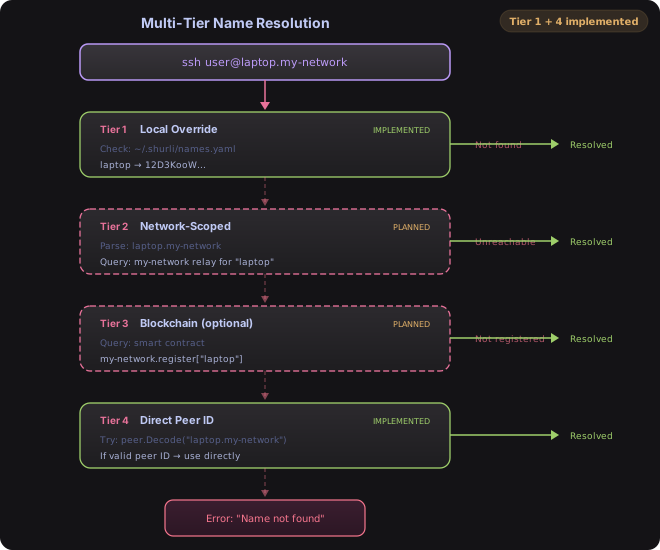
Network-Scoped Name Format
Status: Planned (Phase 9/14) - not yet implemented. Currently only simple names work (e.g.,
home,laptopas configured in local YAML). The dotted network format below is a future design.
Format: <hostname>.<network>[.<tld>]

Examples (planned):
laptop.grewal           # Query grewal relay
desktop.alice           # Query alice relay
phone.bob.p2p           # Query bob relay (explicit .p2p TLD)
home.grewal.local       # mDNS compatible
Federation Model
Status: Planned (Phase 13) - not yet implemented. See Roadmap Phase 14.
Relay Peering
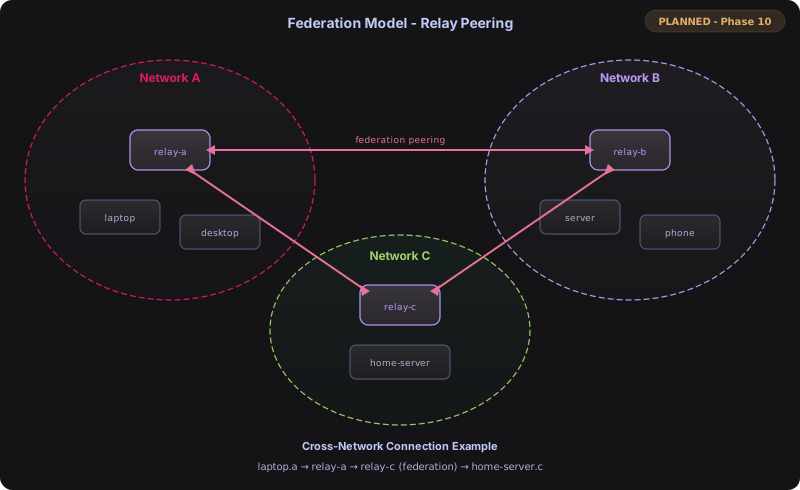
Mobile Architecture
Status: Planned (Phase 12) - not yet implemented. See Roadmap Phase 13.
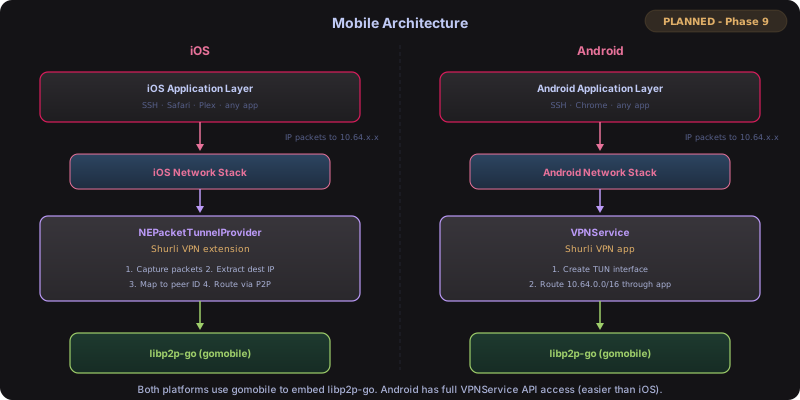
Performance Considerations
Transport Preference
Both shurli daemon and shurli relay serve register transports in this order:
- QUIC (preferred) - 3 RTTs to establish, native multiplexing, better for hole-punching. libp2p’s smart dialing (built into v0.47.0) ranks QUIC addresses higher than TCP.
- TCP - 4 RTTs, universal fallback for networks that block UDP.
- WebSocket - Anti-censorship transport that looks like HTTPS to deep packet inspection (DPI). Commented out by default in sample configs.
AutoNAT v2
Enabled on all hosts. AutoNAT v2 performs per-address reachability testing with nonce-based dial verification. This means the node knows which specific addresses (IPv4, IPv6, QUIC, TCP) are publicly reachable, rather than a single “public or private” determination. Also prevents amplification attacks by requiring the probing peer to prove it controls the claimed address.
Version in Identify Protocol
All hosts set libp2p.UserAgent() so peers can discover each other’s software version via the Identify protocol:
- shurli nodes:
shurli/<version>(e.g.,shurli/0.1.0orshurli/dev) - relay server:
relay-server/<version>
The UserAgent is stored in each peer’s peerstore under the AgentVersion key after the Identify handshake completes (automatically on connect).
Connection Optimization
Relay vs Direct (implemented):
- Always attempt DCUtR for direct connection
- Fall back to relay if hole-punching fails
Connection Pooling (planned):
- Reuse P2P streams for multiple requests
- Multiplex services over single connection
- Keep-alive mechanisms
Bandwidth Management (planned):
- QoS for different service types
- Rate limiting per service
- Bandwidth monitoring and alerts
Items marked “planned” are tracked in the Roadmap under Phase 4C deferred items and Phase 13+.
Binary Size
39 MB stripped (Go 1.26, darwin/arm64,
-ldflags="-s -w" -trimpath)
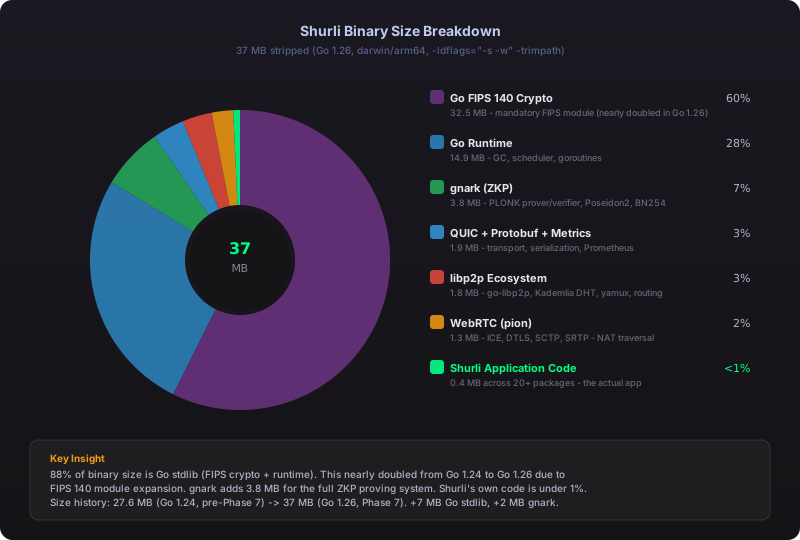
| Component | Debug Size | Why It Exists |
|---|---|---|
| Go FIPS 140 crypto | 32.5 MB (60%) | Go 1.24+ embeds the full FIPS-validated crypto module. Non-optional. Ed25519, AES, SHA, TLS, X.509 |
| Go runtime | 14.9 MB (28%) | GC, goroutine scheduler, memory allocator |
| gnark (ZKP) | 3.8 MB (7%) | PLONK prover/verifier, gnark-crypto field arithmetic, Poseidon2 |
| QUIC + Protobuf + DNS + Metrics | 1.9 MB (3%) | Transport, serialization, resolution, Prometheus |
| libp2p ecosystem | 1.8 MB (3%) | go-libp2p core, Kademlia DHT, yamux, routing helpers |
| WebRTC (pion) | 1.3 MB (2%) | ICE, DTLS, SCTP, SRTP for browser-compatible NAT traversal |
| Shurli application code | 0.4 MB (0.8%) | sdk, relay, daemon, auth, config, invite, vault, zkp, reputation, macaroon |
~88% is Go stdlib (FIPS crypto + runtime). gnark adds 3.8 MB for the full ZKP proving system. Shurli’s own code is under 1%. Every dependency serves a specific function: libp2p for P2P networking, pion for NAT traversal, gnark for zero-knowledge proofs, Prometheus for observability. Nothing to cut.
Security Hardening
Relay Resource Limits
The relay server enforces resource limits via libp2p’s circuit relay v2 WithResources() and WithLimit() options. All limits are configurable in relay-server.yaml under the resources: section. Defaults are tuned for a private relay serving 2-10 peers with SSH/XRDP workloads:
| Parameter | Default | Description |
|---|---|---|
max_reservations | 128 | Total active relay slots |
max_circuits | 16 | Open relay connections per peer |
max_reservations_per_ip | 8 | Reservations per source IP |
max_reservations_per_asn | 32 | Reservations per AS number |
reservation_ttl | 1h | Reservation lifetime |
session_duration | 10m | Max per-session duration |
session_data_limit | 64MB | Max data per session per direction |
Session duration and data limits are raised from libp2p defaults (2min/128KB) to support real workloads (SSH, XRDP, file transfers). Zero-valued fields in config are filled with defaults at load time.
Key File Permission Verification
Private key files are verified on load to ensure they are not readable by group or others. The shared internal/identity package provides CheckKeyFilePermissions() and LoadOrCreateIdentity(), used by both shurli daemon and shurli relay serve:
- Expected:
0600(owner read/write only) - On violation: Returns error with actionable fix:
chmod 600 <path> - Windows: Check is skipped (Windows uses ACLs, not POSIX permissions)
Keys are already created with 0600 permissions, but this check catches degradation from manual chmod, file copies across systems, or archive extraction.
Config Self-Healing
The config system provides three layers of protection against bad configuration:
Archive/Rollback (
internal/config/archive.go): On each successfuldaemonorrelay servestartup, the validated config is archived as.{name}.last-good.yamlnext to the original. If a future edit breaks the config,shurli config rollbackrestores it. Archive writes are atomic (write temp file + rename).Commit-Confirmed (
internal/config/confirm.go): For remote config changes,shurli config applybacks up the current config, applies the new one, and writes a pending marker with a deadline. Ifshurli config confirmis not run before the deadline, the serve process reverts the config and exits. Systemd restarts with the restored config.Validation CLI (
shurli config validate): Check config syntax and required fields without starting the node. Useful before restarting a remote service.
Service Name Validation
Service names are validated before use in protocol IDs to prevent injection attacks. Names flow into fmt.Sprintf("/shurli/%s/1.0.0", name) - without validation, a name like ssh/../../evil or foo\nbar creates ambiguous or invalid protocol IDs.
The validation logic lives in internal/validate/validate.go (validate.ServiceName()), shared by all callers.
Validation rules (DNS-label format):
- 1-63 characters
- Lowercase alphanumeric and hyphens only
- Must start and end with alphanumeric character
- Regex:
^[a-z0-9]([a-z0-9-]{0,61}[a-z0-9])?$
Validated at four points:
shurli service add- rejects bad names at CLI entryValidateNodeConfig()- rejects bad names in config before startupExposeService()- rejects bad names at service registration timeConnectToService()- rejects bad names at connection time
Security Considerations
Threat Model
Threats Addressed:
- ✅ Unauthorized peer access (ConnectionGater)
- ✅ Man-in-the-middle (libp2p Noise encryption)
- ✅ Replay attacks (Noise protocol nonces)
- ✅ Relay bandwidth theft (relay authentication + resource limits)
- ✅ Relay resource exhaustion (configurable per-peer/per-IP/per-ASN limits)
- ✅ Protocol ID injection (service name validation)
- ✅ Key file permission degradation (0600 check on load)
- ✅ Newline injection in authorized_keys (sanitized comments)
- ✅ YAML injection via peer names (allowlisted characters)
- ✅ OOM via unbounded stream reads (512-byte buffer limits)
- ✅ Symlink attacks on temp files (os.CreateTemp with random suffix)
- ✅ Multiaddr injection in config (validated before writing)
- ✅ Per-service access control (AllowedPeers ACL on each service)
- ✅ Host resource exhaustion (libp2p ResourceManager with auto-scaled limits)
- ✅ SYN/UDP flood on relay (iptables rate limiting, SYN cookies, conntrack tuning)
- ✅ IP spoofing on relay (reverse path filtering via rp_filter)
- ✅ Runaway relay process (systemd cgroup limits: memory, CPU, tasks)
- ✅ Unauthorized admin operations (role-based access control + HMAC chain)
- ✅ Root key exposure at rest (Argon2id + XChaCha20-Poly1305 vault)
- ✅ Root key exposure in memory (auto-reseal timeout, explicit zeroing)
- ✅ Invite code bruteforce (8-byte deposit ID, rate limiting)
- ✅ Permission escalation on invites (HMAC chain attenuation-only, cryptographic enforcement)
- ✅ Remote unseal bruteforce (iOS-style escalating lockout: 4 free, 1m/5m/15m/1h, permanent block, admin-only)
- ✅ Relay identity correlation (ZKP membership proofs - relay cannot learn which peer authenticated)
- ✅ ZKP replay attacks (single-use nonces, 30s TTL, cryptographic randomness)
- ✅ Reputation score inflation (range proofs - prove score >= threshold without revealing exact value)
- ✅ DNS seed spoofing (DNSSEC-signed
_dnsaddrTXT records + hardcoded fallback seeds + ConnectionGater rejects unauthorized peers post-bootstrap) - ✅ File transfer path traversal (filepath.Base + sanitization, receive dir jail, no symlinks, regular files only)
- ✅ File transfer resource exhaustion (per-peer rate limiting, pending/active caps, chunk count limit, manifest size limit, timeout)
- ✅ File transfer disk exhaustion (disk space re-checked before each chunk write)
- ✅ Compression bombs (zstd output capped at 10x compressed size per chunk)
- ✅ Transfer ID enumeration (random hex IDs, not sequential)
- ✅ File transfer relay abuse (PluginPolicy blocks relay transport by default for transfers)
- ✅ Command injection in notifications (shell-escape all placeholder values)
Threats NOT Addressed (out of scope):
- ❌ Relay compromise (relay can see metadata, not content)
- ❌ Peer key compromise (users must secure private keys)
Best Practices
Key Management:
- Private keys: 0600 permissions
- authorized_keys: 0600 permissions
- Never commit keys to git
Network Segmentation:
- Use per-service authorized_keys when needed
- Limit service exposure (disable unused services)
- Audit authorized_keys regularly
Relay Security:
- Enable relay authentication in production
- Monitor relay bandwidth usage
- Use non-standard ports
DNS Security:
- Enable DNSSEC on the seed domain (signs
_dnsaddrTXT records) - Enable DNSSEC in your DNS provider’s settings, then add the DS record at your domain registrar
- Defense-in-depth: even without DNSSEC, the ConnectionGater rejects unauthorized peers post-bootstrap, and hardcoded seeds provide a fallback bootstrap path
- Enable DNSSEC on the seed domain (signs
Scalability
Current Limitations
- Relay bandwidth: Limited by VPS plan (~1TB/month)
- Connections per relay: Limited by file descriptors (~1000-10000)
- DHT lookups: Slow for large networks (10-30 seconds)
Future Improvements
- Multiple relay failover/load balancing
- Relay-to-relay mesh for redundancy
- Optimized peer routing (shortest path)
- Distributed hash table optimization
- Connection multiplexing
Technology Stack
Core:
- Go 1.26+
- libp2p v0.47.0 (networking)
- Private Kademlia DHT (
/shurli/kad/1.0.0- isolated from IPFS Amino). Optional namespace isolation:discovery.network: "my-crew"produces/shurli/my-crew/kad/1.0.0, creating protocol-level separation between peer groups - Noise protocol (encryption)
- QUIC transport (preferred - 3 RTTs vs 4 for TCP)
- AutoNAT v2 (per-address reachability testing)
- gnark v0.14.0 + gnark-crypto v0.19.0 (PLONK zero-knowledge proofs, BN254 curve, pure Go)
- zeebo/blake3 v0.2.4 (BLAKE3 hashing for chunk integrity + Merkle trees)
- klauspost/compress (zstd streaming compression)
- klauspost/reedsolomon (Reed-Solomon erasure coding)
- xssnick/raptorq (RaptorQ fountain codes for multi-source download)
Why libp2p: Shurli’s networking foundation is the same stack used by Ethereum’s consensus layer (Beacon Chain), Filecoin, and Polkadot - networks collectively securing hundreds of billions in value. When Ethereum chose a P2P stack for their most critical infrastructure, they picked libp2p. Improvements driven by these ecosystems (transport optimizations, Noise hardening, gossipsub refinements) flow back to the shared codebase. See the FAQ comparisons for detailed comparisons.
Optional:
- Ethereum (blockchain naming)
- IPFS (distributed storage)
- gomobile (iOS/Android)
Last Updated: 2026-03-20 Architecture Version: 6.0 (Phase 9B + Plugin Architecture Complete: Plugin Framework, File Transfer Plugin Extraction, Supervisor Auto-Restart, Security Hardening. Previous: File Transfer, FastCDC Chunking, BLAKE3 Merkle, zstd Compression, Reed-Solomon Erasure, RaptorQ Multi-Source, Parallel Streams, Share Registry, Plugin Policy)