Planned & Future
Relay Decentralization
After Phase 5 PeerManager provides the data:
-
require_authrelay service - enable Circuit Relay v2 service on home nodes withrequire_auth: true - DHT-based relay discovery - authorized relays advertise on DHT under well-known CID
- Multi-relay failover - health-aware selection based on connection quality scores
- Per-peer bandwidth tracking - feeds into relay quota warnings, PeerManager scoring, smart relay selection
- Bootstrap decentralization - hardcoded seed peers -> DNS seeds -> DHT peer exchange -> fully self-sustaining (same pattern as Bitcoin)
- End goal: Relay VPS becomes obsolete - not just optional. Every publicly-reachable Shurli node relays for its authorized peers. No special nodes, no central coordination
Phase 9: Plugin Architecture, SDK & First Plugins
Goal: Make Shurli extensible by third parties - and prove the architecture works by shipping real plugins. The plugins ARE the SDK examples.
Rationale: A solo developer can’t build everything. Interfaces and hooks let the community add auth backends, name resolvers, service middleware, and monitoring - without forking. Shipping real plugins alongside the architecture validates the design immediately and catches interface mistakes before third parties discover them.
Phase 8B (Per-Peer Data Grants), Phase 9A (Core Interfaces), Phase 9B (File Transfer), and the Plugin Architecture Shift are complete. See Completed Work for details.
Phase 8C: ACL-to-Macaroon Migration
Status: M1 complete (Phase 8B). M2-M5 planned.
Replace all five layers of ACL-based access control with macaroon capability tokens.
| Phase | Layer | Current | Replacement | Risk |
|---|---|---|---|---|
| M1 | Plugin/Service | GrantStore + GrantPouch | Macaroon caveats | DONE (Phase 8B) |
| M2 | Share | shares.json peer lists | share_id caveat | Low |
| M3 | Relay | relay_authorized_keys | Token for circuit auth | Medium |
| M4 | Connection | authorized_keys + ConnectionGater | Token in handshake | High |
| M5 | Role | role=admin/member attribute | action caveat | Low |
Phase 8D: Module Slots
Status: Planned (reputation slot designed)
Swappable system algorithms without a full plugin.
| Slot | Current | Next | Enterprise |
|---|---|---|---|
| Reputation | Heuristic scoring | Community Notes matrix factorization | Custom algorithms |
| Auth | Macaroons + PAKE | (current is sufficient) | LDAP, SAML, OAuth2, client certs |
| Storage | Local filesystem | (current is sufficient) | S3-compatible, distributed |
Phase 9C: Service Discovery & Additional Plugins
Timeline: 1-2 weeks
Service discovery protocol and two more plugins that prove different interface patterns.
Service Discovery Protocol:
- New protocol
/shurli/discovery/1.0.0- query a remote peer for their exposed services -
shurli discover <peer>CLI command - Service tags in config:
tags: [gpu, inference]
Service Templates (proves health middleware):
-
shurli daemon --ollamashortcut (auto-detects Ollama on localhost:11434) -
shurli daemon --vllmshortcut (auto-detects vLLM on localhost:8000) - Health check middleware - verify local service is reachable before exposing
Wake-on-LAN (proves event hooks):
-
shurli wake <peer>- send magic packet before connecting - Event hook: auto-wake peer on connection attempt (optional)
Phase 9D: Python SDK & Documentation
Timeline: 1-2 weeks
Repository: shurlinet/shurli-sdk-python (separate repo, ships to PyPI)
Ship the Python SDK and comprehensive documentation. The plugins from 9B/9C ARE the SDK examples.
Python SDK (shurli-sdk):
- Thin wrapper around daemon Unix socket API
-
pip install shurli-sdk - Async support (asyncio)
- Example: connect to a remote service in <10 lines of Python
SDK Documentation:
-
docs/SDK.md- guide for building onpkg/sdk - Example walkthroughs: file transfer, service templates, custom resolver, auth middleware
Phase 9E: Swift SDK
Timeline: 1-2 weeks
Repository: shurlinet/shurli-sdk-swift (separate repo, ships via Swift Package Manager)
Ship a native Swift SDK that wraps the daemon API. This is the foundation the Apple multiplatform app (Phase 12) will be built on. Building it before the app validates the API surface from a non-Go language and catches design issues early.
Swift SDK (ShurliSDK):
- Swift Package (SPM) wrapping daemon HTTP API (Unix socket + cookie auth)
-
Codablemodel types matching all daemon API responses - Core operations: connect, status, expose/unexpose services, discover, proxy, peer management
- Event streaming (SSE or WebSocket) for real-time peer status and network transitions
- Async/await native (Swift concurrency)
- Platform-adaptive transport: Unix socket on macOS, HTTP over localhost on iOS
- Example: connect to daemon and list peers in <10 lines of Swift
Design Constraints: Zero external dependencies (Foundation + Network framework only). Strict concurrency from day one. Works in App Extension context (Network Extensions have restricted APIs).
Phase 9F: Layer 2 WASM Runtime
Status: Planned (research complete, design ready)
Third-party developers write plugins in any language (Rust, Python, JS, C), ship as .wasm files. wazero runtime (pure Go, zero CGo). Hardware-level sandbox isolation.
- WASM plugin loader with capability grants
- Host function bridge (Plugin interface becomes the host-side contract)
- Memory caps, context timeouts, pre-opened directory scoping
- Same CLI experience:
shurli plugin listshows both compiled-in and WASM plugins
Critical dependency: WASI 0.3 (async I/O) expected mid-2026.
Phase 9G: Layer 3 AI Plugin Generation
Status: Future (requires Layers 1-2 solid)
Skills.md describes plugin behavior in natural language. AI agent reads the spec, writes code, compiles to WASM. Zero-Human Network: the network generates its own extensions.
SDK & App Repository Strategy
Non-Go SDKs and consumer apps each live in their own dedicated GitHub repository. The Go SDK (pkg/sdk) stays in this repo since it IS the core library.
| Repository | What | Ships To |
|---|---|---|
shurlinet/shurli | Core daemon + Go library + CLI + plugins | Homebrew, apt, binary releases |
shurlinet/shurli-sdk-python | Python daemon client | PyPI (shurli-sdk) |
shurlinet/shurli-sdk-swift | Swift daemon client | Swift Package Manager (ShurliSDK) |
shurlinet/shurli-ios | Apple multiplatform app (consumer of Swift SDK) | App Store |
Different languages have different release cycles, CI pipelines, and dependency ecosystems. Separate repos let each SDK version independently of the daemon.
Phase 10: Distribution & Launch
Timeline: 1-2 weeks Status: Partial (install script, release archives, relay-setup –prebuilt done. GoReleaser, Homebrew, APT planned)
Goal: Make Shurli installable without a Go toolchain, launch with compelling use-case content, and establish shurli.io as the stable distribution anchor.
Rationale: High impact, low effort. The domain shurli.io is the one thing no third party can take away - every user-facing URL routes through it, never hardcoded to github.com or any other host.
Website & Documentation (shurli.io):
- Hugo + Hextra site, automated docs sync, landing page, blog, CI/CD deploy
- GitHub Pages hosting with custom domain, DNS provider + CDN + DDoS protection
- AI-Agent discoverability:
/llms.txtand/llms-full.txt -
pkg/sdklibrary reference (godoc-style) - Use-case guides (GPU inference, IoT, game servers)
- Install page with platform-specific instructions
Release Manifest & Upgrade Endpoint:
- CI generates
releases/latest.jsonon every tagged release -
shurli upgradefetches manifest fromshurli.io(not GitHub API directly) - Fallback order: GitHub -> GitLab -> IPFS gateway
Distribution Resilience (gradual rollout):
The domain (shurli.io) is the anchor. DNS is managed under our control. If any host disappears, one DNS record change restores service.
| Layer | GitHub (primary) | GitLab (mirror) | IPFS (fallback) |
|---|---|---|---|
| Source code | Primary repo | Push-hook mirror | - |
| Release binaries | GitHub Releases | GitLab Releases (GoReleaser) | Pinned on Filebase |
| Static site | GitHub Pages | GitLab Pages | Pinned + DNSLink ready |
| DNS failover | CNAME -> GitHub Pages | Manual flip to GitLab Pages | Manual flip to IPFS gateway |
| Source links | shurli.io/source/* redirects | Same URLs, different target | Same URLs, different target |
All documentation source references (code paths in engineering journal, architecture docs, etc.) link through shurli.io/source/ instead of directly to any git host. When the primary moves, update one redirect config. Old search engine cached URLs and LLM training snapshots still resolve through the domain we control.
Package Managers & Binaries:
- One-line install:
curl -sSL get.shurli.io | sh(2026-03-24) - Colored ANSI output,
--help,--yes/-y,--upgrade, env vars (2026-03-24) - Release archives (GitHub Actions, tar.gz per platform) (2026-03-24)
-
relay-setup.sh --prebuilt(install from release archive) (2026-03-24) - GoReleaser: Linux/macOS/Windows (amd64 + arm64)
- Ed25519-signed checksums
- Homebrew tap:
brew install shurlinet/tap/shurli - APT, AUR, Docker image
Embedded / Router Builds (OpenWRT, Ubiquiti, GL.iNet, MikroTik):
- Cross-compilation targets:
linux/mipsle,linux/arm/v7,linux/arm64 - Binary size budget: default <=25MB stripped, embedded <=10MB compressed
Auto-Upgrade (builds on commit-confirmed pattern from Phase 4C):
-
shurli upgrade --check- compare version, show changelog -
shurli upgrade- download, verify, replace binary, restart -
shurli upgrade --auto- automatic with commit-confirmed rollback safety. Impossible to brick a remote node.
Use-Case Guides & Launch Content:
- GPU inference - “Access your home GPU from anywhere through Starlink CGNAT”
- IoT/smart home remote access (Home Assistant, cameras behind CGNAT)
- Media server sharing (Jellyfin/Plex with friends via invite flow)
- Game server hosting (Minecraft, Valheim through CGNAT)
- Game/media streaming (Moonlight/Sunshine tunneling)
GPU Inference Config (already works today):
services:
  ollama:
    enabled: true
    local_address: "localhost:11434"
# Home: shurli daemon
# Remote: shurli proxy home ollama 11434
# Then: curl http://localhost:11434/api/generate -d '{"model":"llama3",...}'Phase 11: Desktop Gateway Daemon + Private DNS
Timeline: 2-3 weeks
Goal: Multi-mode gateway daemon for transparent service access, backed by a private DNS zone on the relay.
Client-side Gateway:
- Gateway daemon with multiple modes: SOCKS5 proxy, Local DNS server (
.p2pTLD), TUN/TAP virtual network interface - Virtual IP assignment, subnet routing, trusted network detection
Relay-side Private DNS:
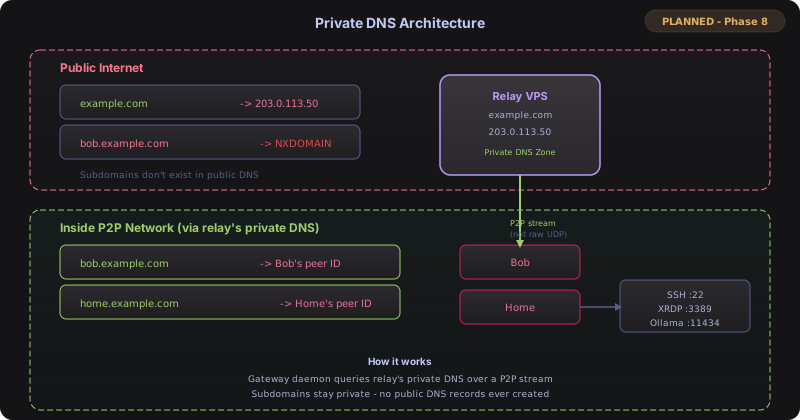
- Lightweight DNS zone on the relay server (e.g., CoreDNS or custom)
- Exposed only via P2P protocol - never bound to public UDP/53
- Subdomains assigned on the relay, resolvable only within the P2P network
- Public DNS returns NXDOMAIN for all subdomains - they don’t exist outside the network
Usage Examples:
# Mode 1: SOCKS proxy (no root needed)
shurli-gateway --mode socks --port 1080

# Mode 2: DNS server (queries relay's private DNS)
shurli-gateway --mode dns --port 53

# Mode 3: Virtual network (requires root)
sudo shurli-gateway --mode tun --network 10.64.0.0/16
Phase 12: Apple Multiplatform App
Timeline: 3-4 weeks
Repository: shurlinet/shurli-ios (separate repo, depends on shurli-sdk-swift from Phase 9E)
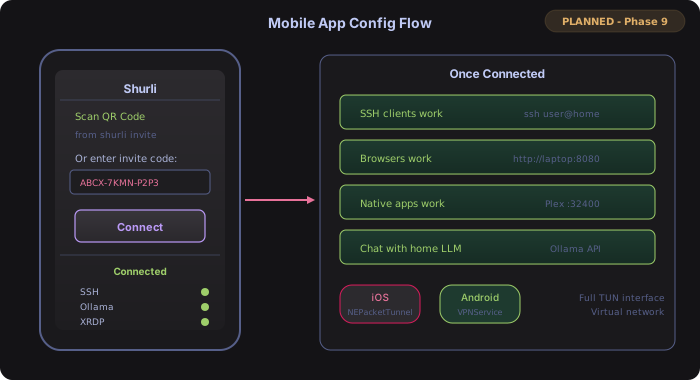
Goal: Native Apple multiplatform app (macOS, iOS, iPadOS, visionOS) with VPN-like functionality and dotbeam visual pairing. The app consumes the Swift SDK (Phase 9E) - it contains zero daemon API plumbing, only UI and platform integration code.
iOS Strategy:
- Primary: NEPacketTunnelProvider (VPN mode) - full TUN interface, virtual network support
- Fallback: SOCKS proxy app (if VPN rejected by Apple)
Deliverables:
- SwiftUI app targeting macOS, iOS, iPadOS, visionOS
- NEPacketTunnelProvider for iOS/iPadOS
- QR code scanning for
shurli invitecodes - Background connection maintenance + battery optimization
- dotbeam visual pairing - animated visual verification replacing emoji fingerprints
Phase 13: Federation - Network Peering
Timeline: 2-3 weeks
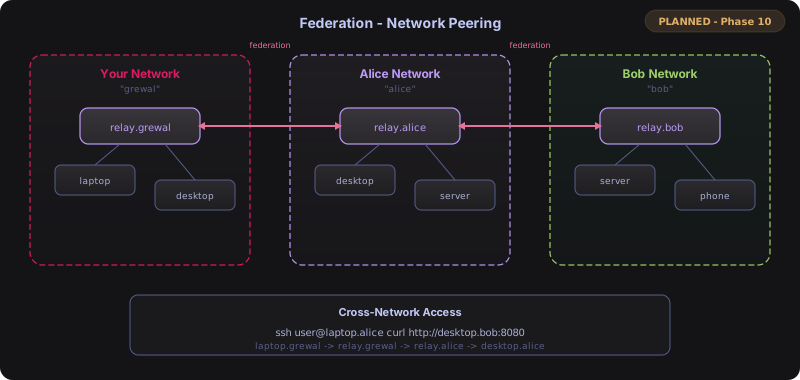
Goal: Enable relay-to-relay federation for cross-network communication.
Deliverables:
- Relay federation configuration
- Network-scoped naming (
host.network) - Cross-network routing protocol
- Trust/authorization between networks
- Multi-network client support
Federation Config Example:
# relay-server.yaml
network:
  name: "grewal"

federation:
  enabled: true
  peers:
    - network_name: "alice"
      relay: "/ip4/45.67.89.12/tcp/7777/p2p/12D3KooW..."
trust_level: "full"Usage:
# From your network, access friend's services:
ssh [email protected]
curl http://desktop.bob:8080
Phase 14: Advanced Naming Systems + Peer ID Prefix (Optional)
Timeline: 2-3 weeks
Goal: Pluggable naming architecture supporting multiple backends.
Name Resolution Tiers:
| Tier | Backend | Cost | Speed |
|---|---|---|---|
| 1 | Local Override (YAML) | Free | Instant |
| 2 | Network-Scoped (relay) | Free | Federated |
| 3 | Blockchain-Anchored (Ethereum) | ~$10-50 one-time | Guaranteed |
| 4 | Existing Blockchain DNS (ENS) | $5-640/year | Premium |
Positioning & Community
Privacy Narrative - Shurli’s Moat
Shurli is not a cheaper version of existing VPN tools. It’s the self-sovereign alternative for people who care about owning their network.
| Shurli | Centralized VPN | |
|---|---|---|
| Accounts | None - no email, no OAuth | Required (Google, GitHub, etc.) |
| Telemetry | Zero - no data leaves your network | Coordination server sees device graph |
| Control plane | None - relay only forwards bytes | Centralized coordination server |
| Key custody | You generate, you store, you control | Keys managed via their control plane |
| Source | Fully open, self-hosted | Open source client, proprietary control plane |
Target Audiences (in order of receptiveness)
- r/selfhosted - Already run services at home, hate port forwarding, value self-sovereignty
- Starlink/CGNAT users - Actively searching for solutions to reach home machines
- AI/ML hobbyists - Home GPU + remote access is exactly their problem
- Privacy-conscious developers - Won’t use centralized VPN services because of the coordination server
Community Infrastructure (set up at or before launch)
- Discord server - real-time community channel
- Showcase page (
/showcase) - curated gallery of real-world deployments - Trust & Security page (
/docs/trust) - threat model, vulnerability reporting - Integrations page (
/integrations) - curated catalog of compatible services
Phase 15+: Ecosystem & Polish
Status: Conceptual
Potential Features:
- Multi-lingual website and documentation (Hugo i18n)
- Web-based dashboard for network management
- Protocol marketplace (community-contributed service templates)
- Bandwidth optimization and QoS per peer/service
- Integration with existing VPN clients (OpenVPN, WireGuard)
- Desktop apps (macOS, Windows, Linux)
- Browser extension for
.p2pdomain resolution - Community relay network
- Split tunneling (route only specific traffic through tunnel)
- Store-carry-forward for offline peers (DTN pattern)
Researched and Set Aside (Feb 2026): The following techniques were evaluated through cross-network research and consciously shelved. They have minimum viable network sizes (10-20+ peers) that exceed Shurli’s typical 2-5 peer deployments. At small scale, they add overhead without benefit. Revisit when Shurli grows to networks of 20+ peers.
- Vivaldi network coordinates (latency prediction)
- CRDTs for partition-tolerant peer state
- Slime mold relay optimization
- Shannon entropy connection fingerprinting
- Percolation threshold monitoring
- VRF-based fair relay assignment
- Erlay / Minisketch set reconciliation
Protocol & Security Evolution
- MASQUE relay transport (RFC 9298) - HTTP/3 relay alternative to Circuit Relay v2
- Post-quantum cryptography - hybrid Noise + ML-KEM (FIPS 203) handshakes
- WebTransport transport - native QUIC-based, browser-compatible
- Zero-RTT proxy connection resume - QUIC session tickets for instant reconnection
- Hardware-backed peer identity - TPM 2.0 (Linux) or Secure Enclave (macOS/iOS)
- eBPF/XDP relay acceleration - kernel-bypass packet forwarding
- W3C DID-compatible identity -
did:key,did:peerformat - Formal verification of invite/join protocol state machine
ZKP Watching List
Checked after each phase completion:
- Halo 2 in Go - if a native Go implementation appears, it would be a strict upgrade (removes ceremony dependency). Zero activity as of 2026-03-01.
- gnark Vortex - ConsenSys’s lattice-based transparent setup. Would remove ceremony dependency entirely if it reaches production.
- gnark IPA backend - would enable Halo 2-style proofs in gnark.
Deferred from Phase 7:
- Private DHT namespace membership - prove namespace membership without revealing the namespace name (deferred to Phase 13 federation work)
Success Metrics
Phase 4A: Library importable, 3+ services documented, SSH/XRDP/TCP working
Phase 4B: Two machines connected via invite code in under 60 seconds, zero manual file editing
Phase 4C: CI on every push, >60% overall coverage, relay resource limits, auto-recovery within 30s, commit-confirmed prevents lockout, QUIC transport default
Phase 6: Client-generated async invites work, relay sealed/unsealed with auto-lock, remote unseal over P2P, admin/member roles enforced
Phase 7: ZKP proves membership without revealing identity
Phase 8: Unified BIP39 seed, encrypted identity, remote admin over P2P, MOTD/goodbye
Phase 9: Third-party plugins work, file transfer between peers, Python + Swift SDKs published (separate repos)
Phase 10: One-line install, shurli upgrade --auto with rollback safety, GPU inference guide published
Phase 11: Gateway works in all 3 modes, private DNS resolves only within P2P network
Phase 12: Apple multiplatform app approved, QR invite flow works, dotbeam visual pairing live
Phase 13: Two networks federate, cross-network routing works
Phase 14: 3+ naming backends working, plugin API documented